Charlotte Trecartin’s TikTok Hack That Built CharCharms Into a Multimillion-Dollar Brand
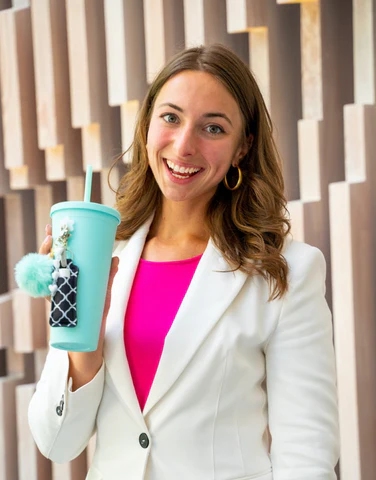
Charlotte Trecartin’s idea for CharCharms came from being bored at home during a pandemic semester, sitting in a sunroom with a tumbler, and wondering why she had nowhere to hang her hair tie except her wrist. That single, small irritation — solved with a sketch, a Photoshop render, and a hook design — became a water bottle accessory company that now sits on shelves at Target and Dick’s Sporting Goods, appeared on ABC’s Shark Tank, and was generating an estimated $6.5 million in annual revenue as of early 2025, with growth continuing since. It’s also one of the clearer, more recent examples of a strategy that’s become common among Gen Z founders: treat a TikTok coaching subscription as a real line-item business expense, not a vanity project, and let consistent, high-volume short-form content replace a traditional marketing budget almost entirely.
This is the detailed version of that story — what Trecartin actually did, what it cost, what didn’t work before it did, and what’s transferable to other small consumer brands trying to use the same playbook in 2026, when TikTok-native growth is far more competitive than it was when CharCharms started.
A Hair Tie, a Sunroom, and a Pandemic Idea
In the fall of 2020, Trecartin was a junior at the University of Illinois Urbana-Champaign, pursuing a business degree with minors in chemistry and exercise science, attending classes virtually due to the pandemic. As a competitive bodybuilder, nanny, and cycling instructor who carried a water bottle everywhere, she had a small, specific frustration: nowhere convenient to put a hair tie except her wrist or a pocket. The idea that followed — a hook that could hang accessories directly off a water bottle — was sketched and rendered the same evening, then shared with friends for early feedback.
That idea didn’t immediately become a business. By Trecartin’s own account, she didn’t get much further than initial concept sketches that first summer. The gap between having the idea and actually launching a product took roughly a year, filled with informal conversations with other young entrepreneurs and early mentors who encouraged her to keep developing it rather than abandon it.
Building From Her Dad’s Basement
CharCharms launched its first product collection on September 24, 2021, and made its first sales that same fall and winter. The operation at this stage was genuinely small-scale: products were made from Trecartin’s father’s basement, with a team consisting of local high school students and neighbors hand-pouring stick-on hooks into molds and assembling bead charms by hand. There was no outside manufacturing partner and no warehouse — just a founder, a handful of part-time helpers, and a kitchen-table-scale production process.
This detail matters for context: unlike several of the larger personal-brand businesses built on existing fame or prior business exits, CharCharms started with essentially no capital advantage and no pre-built audience. The entire growth story from this point forward had to be earned through content and word of mouth rather than purchased through advertising or jump-started by an existing following.
The First TikTok Coach That Didn’t Work
Trecartin’s first attempt to professionalize her TikTok growth involved hiring a coach for $2,000, a relatively large expense for a basement-stage startup. By her own account, this investment didn’t pay off — she described it as a mistake, recognizing that the engagement wasn’t structured in a way that actually built her skills or audience effectively. She then tried growing the account independently for a period, which she has described as failing “miserably,” leaving her frustrated but not willing to abandon the effort entirely.
This detail is worth including specifically because most retellings of creator-led growth stories skip the failed first attempt and jump straight to what worked. The actual sequence — an expensive coaching engagement that didn’t deliver, followed by a frustrating solo period — is a more honest and more useful picture of what building TikTok-driven growth from zero typically looks like than the polished, single-success-story version that circulates after the fact.
The $300-a-Month Fix: Consistency Over Cleverness
What changed the trajectory wasn’t a more expensive coach or a cleverer content idea — it was a cheaper, more accountability-focused engagement, reported at roughly $300 to $400 per month, that helped Trecartin establish and maintain a consistent posting schedule. Under this coaching relationship, she began posting about CharCharms three times per day, a volume far beyond what most small business accounts attempt, treating content output itself as the primary growth lever rather than waiting for an individual video to go viral.
The lesson Trecartin has repeated most consistently in interviews and her own writing is unglamorous by design: posting frequency and consistency mattered more than any single piece of “hacking the algorithm” cleverness. This is a meaningfully different emphasis than much of the popular advice circulating about TikTok growth, which tends to focus heavily on trends, sounds, and format novelty rather than the more boring, harder-to-sustain discipline of showing up daily regardless of how any individual post performs.
The Playlist Tactic: Organizing Content by Niche
The second specific tactic Trecartin has credited with meaningful growth is the use of TikTok’s playlist feature to organize videos by niche or topic, making it easier for users interested in a specific type of content — water bottle accessories, sustainability messaging, behind-the-scenes founder content — to find and follow a concentrated thread of relevant videos rather than scrolling through an undifferentiated feed of everything the account had posted.
This tactic reflects a broader principle that’s become more important as TikTok’s content volume has grown: discoverability increasingly depends on helping a platform’s recommendation systems and its users quickly understand what a specific piece of content is about and who it’s for, rather than relying purely on broad virality. For a niche physical product business like CharCharms, playlists effectively let Trecartin run several parallel content channels under one account without diluting any single thread’s relevance to the audience actually interested in it.
From TikTok Comments to Target Shelves
As the TikTok following grew toward and past 50,000, then 80,000 followers, the audience itself functioned as both a customer base and, eventually, a credibility signal to retail buyers. CharCharms’ visibility on the platform attracted the attention of Dick’s Sporting Goods, where the brand secured placement in 60 stores before expanding to more than 100 locations, and later Target, two retail relationships that would have been considerably harder to secure for an unknown, founder-run accessory brand without a demonstrable, engaged online following already validating consumer demand.
This sequence — audience first, retail credibility second — mirrors a pattern seen across several of the larger personal and consumer brands built primarily through social platforms: a visible, engaged following functions as free market research and a pitch asset simultaneously, lowering the perceived risk for a retail buyer deciding whether to take a chance on shelf space for an unproven product line.
The Cross-Posting Discovery: One Video, Four Platforms
One of Trecartin’s more specific, tactically useful discoveries, which she has written about directly on LinkedIn, involved cross-posting the same content across platforms rather than treating each platform as requiring entirely separate content. A CharCharms video that performed unremarkably on TikTok was posted to Facebook Reels and, three months later, suddenly went viral there, generating over two million views from a single previously “non-viral” clip.
The lesson she’s drawn from that experience, and shared publicly as advice to other small brands, is that content has a different lifespan and audience fit on each platform, and that a video underperforming in one place doesn’t mean it has no value — it may simply not have found the right platform or moment yet. For a small team without the resources to produce platform-specific content for every channel, cross-posting the same core content across TikTok, Instagram, Facebook, and YouTube maximizes the chance that any individual piece of content eventually finds its audience somewhere, without multiplying production costs.
Shark Tank: Walking Away Without a Deal
CharCharms’ highest-visibility moment came via an appearance on ABC’s Shark Tank, in an episode that aired in February 2025. Trecartin sought $300,000 in exchange for a 10% equity stake, framing her ask explicitly around wanting a partner who would invest in her as a founder as much as in the business itself. The pitch drew a mixed reception: Kevin O’Leary was openly skeptical of the product category, remarking that there was “a lot of crap like this on the market,” while Daymond John expressed more interest, citing potential licensing opportunities with larger brands.
O’Leary ultimately offered $300,000 for 25% equity, citing distribution concerns, while John offered the same amount for 20%, with both later coming down — to 20% and 17.5% respectively — after Trecartin countered with an offer of 12.5%. Neither side closed the gap; Trecartin was unwilling to give up more than 15% of the company, and she left the show without a deal. Notably, she reported a sales increase in the days immediately following the episode’s broadcast, a common outcome for Shark Tank appearances even when no investment deal is reached, since the show itself functions as a substantial marketing and distribution event independent of any resulting partnership.
What CharCharms’ Revenue Actually Reflects
The most reliable, sourced figure available for CharCharms’ financial performance comes from CNBC’s reporting at the time of the Shark Tank episode, which cited the company as on track to bring in approximately $6.5 million in annual revenue. That figure represents a specific, attributed data point rather than a vague approximation, and it should be treated as the most defensible baseline for understanding the business’s actual scale as of early 2025.
Claims that CharCharms has since crossed $10 million in revenue are plausible given the brand’s continued retail expansion and growing social following, but have not been independently confirmed through reporting comparable to the CNBC figure. Readers and other founders studying this case should treat any “$10 million-plus” framing as an estimate of likely continued growth rather than a verified, sourced number, a distinction worth maintaining particularly given how often founder-reported growth figures in social media coverage outpace what’s later confirmed through audited financials or acquisition disclosures.
The Limits: Skepticism, Saturation, and What “TikTok Famous” Doesn’t Guarantee
O’Leary’s on-air skepticism about CharCharms — that the water bottle accessory category was crowded with similar products — points to a real structural risk in TikTok-driven consumer brands generally: a following built through engaging content doesn’t necessarily indicate a durable, differentiated product moat. Categories that are easy to demonstrate visually and cheaply on short-form video, like water bottle accessories, phone cases, or novelty kitchen gadgets, tend to attract many competing entrants once a format proves it can generate engagement, which can compress margins and shorten any individual brand’s window of differentiation.
A second limitation worth naming honestly: the TikTok growth playbook that worked for CharCharms in 2021 and 2022 operated in a considerably less saturated creator-commerce environment than exists in 2026, when significantly more small brands are actively competing for the same short-form attention using broadly similar tactics. Consistency and platform-native content remain necessary, but they’re no longer sufficient on their own to guarantee the kind of breakout growth CharCharms achieved in its earlier years — a caution worth applying to anyone treating this case study as a guaranteed formula rather than one successful execution of a now-more-contested strategy.
Five Lessons From the CharCharms Playbook
Setting aside the specific product category, there are clear, transferable principles in how this brand was actually built:
- Pay for accountability, not just expertise. The cheaper, $300-a-month coaching engagement worked because it enforced consistent posting discipline, not because it offered more sophisticated strategic advice than the earlier, pricier coach.
- Treat posting volume as a real growth lever, not a vanity metric. Three posts per day, sustained over months, mattered more than waiting for a single perfectly crafted viral video.
- Use platform-native organization tools, like playlists, to aid discoverability. Helping the algorithm and the audience understand what each piece of content is about made the existing content work harder without producing more of it.
- Don’t assume a piece of content has failed permanently. Cross-posting the same video across platforms surfaced a viral outcome three months after its original, unremarkable TikTok performance.
- Let an engaged following do the retail pitching for you. A visible, growing audience functioned as proof of demand that helped secure Dick’s Sporting Goods and Target placement without requiring a large existing sales team.
Where the Brand Goes From Here
As of 2026, Trecartin continues operating CharCharms while also building a parallel media and consulting presence — hosting a podcast called “As A Creator,” teaching a media entrepreneurship class at her alma mater, and appearing on Forbes’ 30 Under 30 list — suggesting a strategy of diversifying her personal brand alongside the product business rather than relying on CharCharms alone for long-term growth. The open question for CharCharms specifically is whether it can maintain differentiation in an increasingly crowded water-bottle-accessory category as more competitors adopt similar TikTok-native growth tactics, or whether continued retail expansion and product line extensions will be required to sustain the growth rate that took the brand from a basement operation to national retail shelves in under five years.
Frequently Asked Questions
How much revenue does CharCharms make?
CNBC reported the company on track for approximately $6.5 million in annual revenue around the time of its February 2025 Shark Tank appearance. More recent figures, including any claim of surpassing $10 million, have not been independently confirmed.
What is CharCharms?
It’s a water bottle accessory brand founded by Charlotte Trecartin in 2021, selling charms, straws, straw toppers, hooks, and pouches that attach to reusable water bottles, sold online and through retailers including Target and Dick’s Sporting Goods.
Did Charlotte Trecartin get a deal on Shark Tank?
No. She sought $300,000 for 10% equity; offers from Kevin O’Leary and Daymond John required more equity than she was willing to give up, and she left without a deal, though sales rose in the days after the episode aired.
How did Charlotte Trecartin grow CharCharms on TikTok?
She hired a TikTok coach for roughly $300 to $400 per month, posted three times daily, and used content playlists organized by niche, growing her account to roughly 80,000 followers and attracting retail interest.

We create powerful, insightful content that fuels the minds of entrepreneurs and business owners, inspiring them to innovate, grow, and succeed.