Inside the Creation of Benjamin Nathan Bell, the Real First AI Actor Hollywood and Tilly Norwood Didn’t See Coming
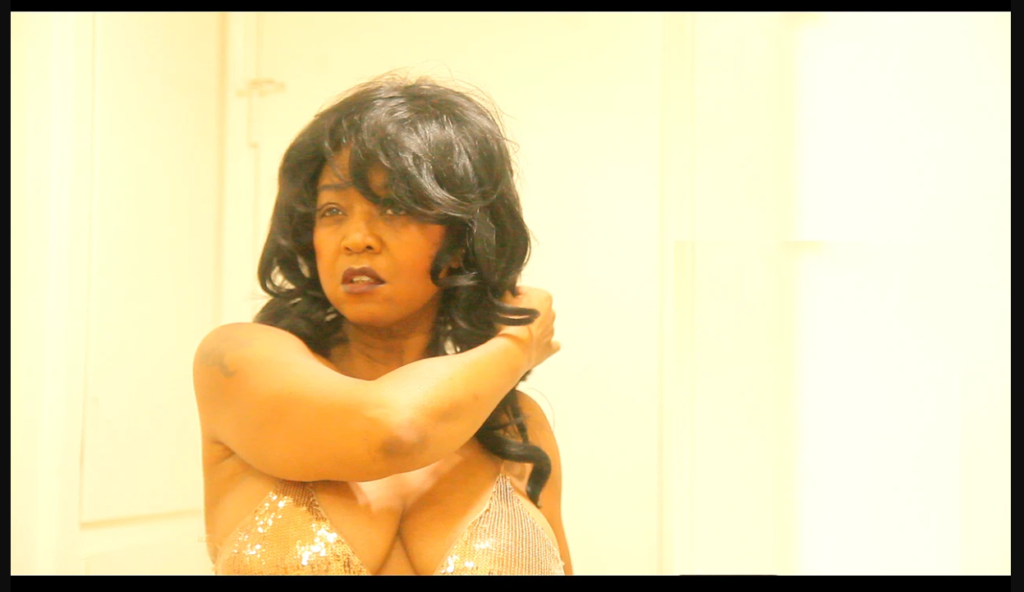
Los Angeles movie director and AI consultant Heather Ferreira
Unlike the charming Tilly Norwood original story of British stand-up comic Eline Van Der Velden, set in a sudden soap detergent commercial thought balloon “poof” one night in the Groucho Club that likely never happened, Los Angeles movie director and AI consultant Heather Ferreira’s explanation of how and why the real “first AI actor” was created and how Ferreira accomplished that well before Van Der Velden is grittier and sadder, with a much more believable backstory and reason:
“I was stalked, groped and sexually harassed by human actors,” she says.
The idea to come up with an actor incapable of doing that didn’t first happen in a posh private club in London. Ferreira wasn’t working with a fifteen-person team. And when she realized she had just created the first real and functional, walking, talking, performing AI actor, she did not instantly pivot to “and now how can I get daddy to buy me as many online magazine article placements about this as possible?”
Instead, she continued quietly working, a choice she says she believes is directly responsible for that AI actor creation having now starred in two full-length motion pictures, his own sitcom, Up In Smoke, airing on Ferreira’s own new AI-generated original day and prime time content television and movie network TTN (www.thetelevisionnetwork.com), which she also created, why he stars on her AI educational TV children’s series Firecracker Factory, was a guest host on AI variety comedy show The Buddy Martini Show (whose titular star, the first AI Italian-American stand-up comic, is a contentious but startlingly realistic – and funny – member of her 27-star AI actor stable).
“Creating and announcing 27 new AI stars at my company was my homage to Paramount Pictures, who have 27 stars around the mountain seen in their logo to symbolize the first 27 actors they had when Paramount started out as Famous Artists,” explains Ferreira.
“After I and my little team announced on my page we were launching a 27-star AI actor stable, though, Eline Van Der Velden announced a few days later she and Particle 6 were suddenly launching an AI actor stable, except hers would have 40 actors, not a mere 27. I should note here, those 40 actors still do not exist yet. Mine do and can all be seen acting in shows and my movies already, so why did she announce hers? Unfortunately, it was the beginning of a whole ordeal I and my team have been going through from Van Der Velden, with her reading things we’ve done then trying to one-up them.
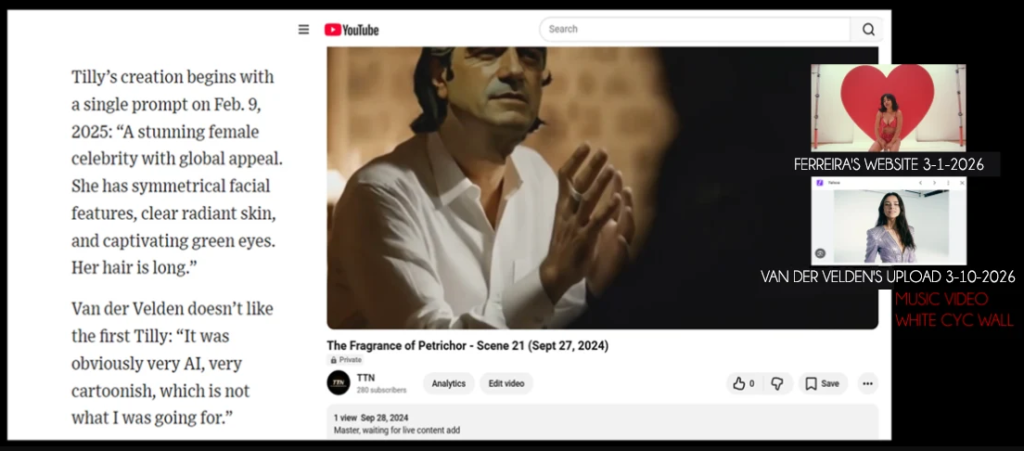
“I never mentioned Paramount as the reason for exactly 27 actors in our announcement, so she had no inkling why our AI stable already had 27 actors. She just stole that and announced she had 40, to try to seem ‘bigger’ than we were. But it only wound up showing she knew nothing about Hollywood. She has a history of doing this to us. On March 1, 2026, I shot an AI music video starring myself the way I looked as a recording label artist during the Nineties, and announced and posted stills of it with me in pop singer attire singing a pop song of my own written to my boyfriend and dancing in front of a white cyc wall soundstage.
“Nine days later on March 10, Eline Van Der Velden suddenly announced actress Tilly Norwood was somehow now also a pop singer, and she uploaded a music video of her doing the exact same thing in front of a white cyc wall soundstage. Keep in mind the ‘stable of AI actors’ comment she made a few days after mine. Now add this. At this point it was becoming laughable, but I kept on working.”
Ferreira says what drove her to AI actors was persistent human actor misbehavior.
She says, “There’s a lot of drugs, mental illness and harassment in Hollywood, but the biggest, ugliest secret is it’s mostly the actors all doing it. We all get to see news stories where a male director or producer gropes or harasses an actor. Those stories get promoted. But a simple Google search quickly reveals the people doing the most horrible, mentally ill things in Hollywood are the actors. If you search term ‘Crazed set designer murders extra’ or ‘Crazed director rapes seven grips’, you won’t find a whole lot of articles. But if you search term ‘Crazed actor’…?” She smirks. “Mmm?”
She continues, “I would in fact calculate 97% of all actors working and non-working in Hollywood are mentally unwell. It’s just a mentally non-holistic profession. SAG would dispute this. But SAG-AFTRA’s own symbol is, despite its Greek stage origin, a depiction of bipolarity. The Greeks were the smartest nation on the earth and, sometimes, the Greek truth is often there in plain sight.”
One incident Heather Ferreira says she had to deal with dangerous actor mental illness on set was reportedly in Burbank in August of 2017. After recasting a role in her lauded series Movieopolis (listed as a Sept 2026 TTN relaunch starring AI actors) with a Wisconsin based actor, Ferreira says the actor offered her narcotics on set then invited her to join him for a three-day sex and drug romp at his wife’s condominium while the wife was away on a trip. When Ferreira refused, the actor retaliated.
First he reportedly performed a walkout (“a common punishment actors inflict on directors who refuse to kiss their ass, or to take drugs or sleep with them,” according to Ferreira) then assumed multiple Twitter and Facebook alter egos and bombarded her and the page of Movieopolis with so many rants, attacks and hate messages to and about her she shut the page down. He accused her of what he instead had done to her, issued her death threats, posted images of a black woman cut headless, messaged her “nobody would ever love” her and she would “always be single”, and threatened to cut apart her vagina with garden shears. She claims the actor did this to her for years but “neither police nor lawyers would do anything.” But the shocking aside to this is Ferreira says she is not new to this harassment. She states she has been stalked by actors in this and even more lurid ways numerous times, and that she is far from the only film director subjected to actor harassment. She mentions even Steven Spielberg was.
“Oh, they (actors and actresses) do it all the time,” she reveals. “It’s a dirty little secret in Hollywood only insiders know, and it paradoxically worsened during the whole MeToo phenomenon. MeToo did not and doesn’t protect directors and crew very well when actors are doing the harassing. They are a weapon solely available to the acting community. Law enforcement in LA County largely ignores actor harassment, too. I was left vulnerable for years. Literally every production had at least one incident of an actor harassing me. I and my producer were bleeding money on shows because we were constantly putting out fires these people were causing. So, the moment I saw artificial intelligence could remove me from human actors and protect me from their unmedicated behavior – I went for it right then. It was a way to make films without having to continually be on guard around some very scary people.”
Ferreira says, “As I’ve said, my reason for using AI was being sick of human actor sexual harassment. That’s why it became really hard to watch someone from another country, not from Hollywood, who knows nothing about filmmaking and nothing about AI, and who went through none of what I did as the reason to create artificial actors, suddenly collapse through the ceiling into my world like a 1960’s stripper dancer bursting uninvited out of a cake, stealing and claiming the credit for my work.
“But then, she began as an aspiring actress: so the arrogance contained within and behind what she was doing to me is frankly unsurprising. They are an unmedicated, very unwell people, and they don’t think things carefully through the way the rest of us do. Actors are very Cookie Monster: me want me take.”
Ferreira raises an interesting point: Van Der Velden appears to have arrived upon AI with no prior path or interest leading up to it, as if a sudden castle in a Dutch forest. How did she discover AI and what made her interest in it? Did “spirit guides in the Groucho Club” whisper “use AI” to a failed stand-up?
As an established and multiple-award-winning film and television director who was tapped by Warner Bros Pictures in 2019 to develop features with them, Ferreira had a believable background in working with and around actors and what an artificial actor would need to be trained with, possess and exhibit to be credible onscreen. As a director with intensive background in science, she wrote the 2020 sequel to Stanley Kubrick’s 2001: A Space Odyssey a Wolper Organization exec, Kevin Nicklaus, greenlighted as that upcoming Warner sequel, “and only Covid interrupted it,” says Ferreira. “We had gotten to a point in 2001: II production where Kevin and I were examining production designers and DPs for it.”
As former motion picture directing and cinematography lighting and movement generation replication consultant to Stability AI, who tapped her to serve as a guide as they improved their burgeoning AI generators, Ferreira had sufficient technical knowledge of AI and how AI generation really works to show a legitimate path to creating the first functional AI actor, and this path is important: it proves who did what when and how and how they got there. Eline Van Der Velden may share such a path, but as Heather Ferreira has rightly pointed out, so far no articles about or interviews with Van Der Velden seem to show one.
Instead according to Ferreira, “It looks more like the momager path and a momager kind of motive, and most people really in Hollywood finally seem to be waking up from the spell and starting to notice. What difference is there between Baby June and Tilly Norwood? The real question arising is, is Eline Van Der Velden any different from Rose Hovick? I would say no, not really. She’s Rose Hovick with a computer. And that’s fine, but don’t use your computer and lust for fame to lie to the world that precious Baby June was the first-ever toe dancer and use that to source your publicity.
“Because the real first-ever toe dancer will probably confront you on that and also sue you and, in a California courtroom, you will lose.”
Ferreira did not use 23 generic words to prompt something as important as “the first-ever AI actor”, one with the right “it factor” to crack through Hollywood, soften its resistance, and lure audiences. With her background in AI and AI consultancy, and in film directing, she knew creating something with that much responsibility would require much greater specificity and precision.
To invent Benjamin Nathan Bell, her actor preceding by years Van Der Velden’s, Heather Ferreira used thousands of words and then trained loras, “a term my follower has strangely never used in two years of false publicity,” notes Ferreira. “She also has avoided terms such as I2V and V2V that you would think were absolutely integral to the AI actor generation process. She seems continuously strangely unaware of these terms whereas most of us who use the processes talk about them. We geek about them. We’re excited about them. Yet I don’t believe she has mentioned loras and training in a single gooey, glazing article or interview she paid to sit for about how she created this mysteriously empty- looking Baby June. Instead, from all I’ve unfortunately been forced to read, she seems to consistently characterize the creation of Tilly as having had ChatGPT draw a generic dark-haired girl for her, and then there is this constant implied ‘Bippity Boppity Boo! Insert jazz hands!, Magic happens!, Now Tilly’s in a movie!’ out of Ms. Van Der Velden in all these interviews, and I feel almost embarrassed for her and want to be a Zoomer and say, Um, Mom…?” Ferreira quiets. “… AI doesn’t work like that.”
Pointing to a Magnolia Avenue office’s whiteboard and writing fast on it, Heather continues for me, as though I am a student in some class for AI, “AI model prompting doesn’t work that way. An actress doesn’t appear like magic. A movie doesn’t appear like magic. The shots of a movie, the script of a movie – none of these things are ever mentioned by her yet she characterizes this FedEx color drawing as ‘Tilly, the movie actress’. WHAT MOVIE? The consistent ‘And Then Magic!” in all her talk, to me, makes it more obvious she’s never done this before, she doesn’t know what she’s talking about, and is just a digital momager trying to use a prettier and synthetic surrogate daughter to become famous.
“To uphold AI character consistency, the absolute sine qua non of model creation and movie character technology, really strict lora training using adequate software that can maintain absolute consistency of your character is a must. Not just as ChatGPT drawings. As actual, moving people. She claims Tilly is an actress, well then make her act, then. Why have we not seen her actually speaking as in clearly playing a role yet, for all of this talk of her being the first and you being the first, with no movie yet? My AI actor has been in movies. Full-length, people seated in an audience, award-winning movies. So where are yours? Would be my question to her. Since you were ‘first’?
“’Upcoming’. ‘Coming soon: PS, we’re hiring’. She should have hired these people two years ago. She clearly doesn’t know how to make her do it, so she’ll have to hire outside people to make Tilly talk and move because she can’t. It isn’t an actress: it’s a FedEx glossy photo. The people she hires, and she is “hiring”, by the way, will know and have to know all the stuff I’m showing you here and talking about. Loras. Diff. Hallucination suppression. Training. Way more. These are the things you have to know as of even 2026 to make a realistic human-looking character act onscreen. Which Tilly still hasn’t.
“And one would think she knew this. She claims to be a scientist. But nope, no mention of loras, no diff, no mention of hallucinations: ever. It’s surprising. So for this failed TV day player to claim she invented the first AI character, that she’s a phy[sic]ist, to magically somehow be expert in all these things yet never even once use any of the correct terminology? To continually instead use hints of mommy magic, suburban subdivision sparkles and jazz hands to explain what I just did in real AI gen lang and not ever get caught? Not even get asked?
“Because nobody stopped her. No one investigated. No one asked one question. They let her just talk, talk, and talk. Sure, she got roasted, but only by other jealous actresses like herself and for strutting out on their career sidewalk turf acting like the best new whore and broader than Broadway. That, angering other actresses, here in Hollywood and not Holland or wherever she’s from, was of course what got her finally questioned and roasted. But not for the Science. I’m amazed not one journalist stopped or ever questioned her on this. About her complete ignorance and illiteracy of the Science.
“Well, I’m asking,” states Ferreira. “As the woman who really did solve this equation and do it first, I’m looking Eline Van Der Velden in the eye right now and saying, ‘Show the math. Show your work.’ And if she really is a physicist not based upon someone else’s work, she will know what that sentence means and she’ll do it. It’s time for her to show us the metadata. She won’t, of course.
“Because she knows they are dated later than mine.”
According to this metadata, which Ferreira showed me sometimes exhaustively, at length – gigabytes and gigabytes full of folders, files, essays, schematics, Meisner discussions, even moving screencapture videos – she was first and she is right. Benjamin Nathan Bell is the actual first documented walking, talking, acting artificial Hollywood actor.
According to .png metadata such as ICC, XMP, dates and more, he first appeared on or before March 21, 2023, as a character designed for Ferreira’s groundbreaking three-hour almost Biblical movie epic Atlantis: The Motion Picture, and during that film’s apparent two decades of preproduction, as she used AI to begin creating costumes and characters for it. The movie is due in theaters this year. She says she used three American Founding Fathers and more than a thousand prompts, “and intense curating”, to sculpt him from an actor seen clearly in her mind before starting to design any, and that he was upright and acting, “not just staring at the camera moving his lips to a Suno song’s lyrics”, months, arguably years before Eline Van Der Velden’s Tilly Norwood. The facts do seem to bear out the claim: one video of Bell credibly acting on YouTube, one of “dozens” according to Ferreira, clearly shows its upload date as September of 2024. Norwood first appeared as a ChatGPT drawing in February 2025.
What separates Ferreira’s achievement from the conversation currently dominating AI entertainment discourse is not just the timeline. It is the scale of ambition and absence of infrastructure. Van Der Velden worked with a fifteen-person team and spent more than $60,000 creating a character whose first feature film has not only not been completed – but has not even been started.
In contrast Ferreira worked alone: one director, one vision, and completed a nearly three-hour motion picture featuring an entirely AI-generated lead actor who walks, speaks, emotes, commands armies, and carries the entire moral weight of the film on his digital shoulders. Benjamin Nathan Bell does not have llama eyelashes. He did not arrive with half a forehead missing. He wasn’t conjured with girlish witchy hand motions and Hot Topic grimoire level baby-prompts invoking “And make him beautiful. And glamorous. An international star to reckon with.” He didn’t require 2,000 iterations to finally find his face. He had one. His film director creator apparently knew that face before creating it and spent prompt and curation time to lock it down. He then stepped out of the loras onto a balcony overlooking fictional Atlantis on March 21, 2023, “and then actually did something, such as acting.”
“So, how did Ferreira prompt and create Bell, and what images if any did she use to train all the loras she utilized? “I mostly trained them on The Founding Fathers,” she laughs. “I’m a U.S. Constitution and history geek who thinks a few of our nation’s Founding Fathers were pretty hot. Not a popular consensus I realize. But to me, many were. I used exactly three, and I am not divulging on which three the loras were trained. If you have eyes, at least two are probably obvious.
“It wasn’t magic, nor was it jazz hands or mommy-sparkles,” says Ferreira. “Benjamin’s face, his height, his bearing, the masculine authority he gets across onscreen. Even that little ‘flip’ he has to his hair in back. That was all just loras, me, and literally thousands of prompts, then curating the prompts because I had in mind exactly what I wanted to see until I finally saw it. Curating is yessing or noing the results you get, then asking for closer and more. That’s the part of AI creation Eline knew and it strikes me as very exec: it suggests she was an exec giving notes on what the real workers were doing and making and spending labor on, and then showing her.
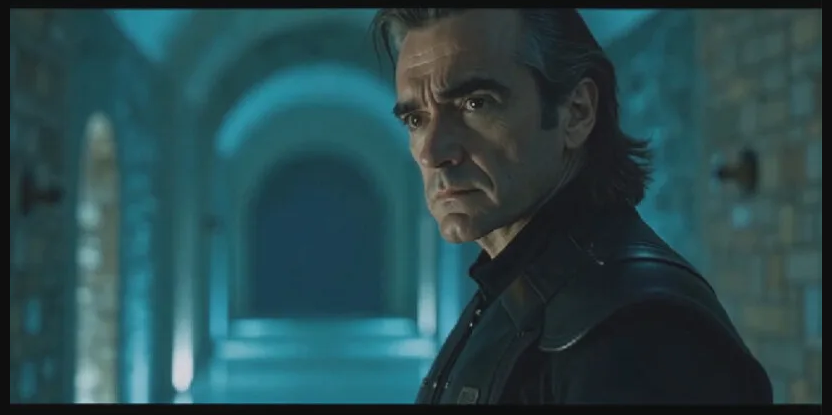
“The actual work, the actual forming of what she yessed or noed, and how that happened, she seems consistently eerily blank about. To protect myself and my process because it is proprietary, I never mentioned my exact work path and tools in any of the 2024-2025 interviews about me, and the tools I did mention I switched names on and misled to keep the path obscure, whenever discussing AI and Benjamin on my page Eline liked to secretly visit at Film Freeway.
“I strongly suspect this is why Van Der Velden remains unable to describe her own work path. Mine was not there to stripmine for the correct terms, the process, the architecture and content like the other things that she was able to take and quote. My team and I know she visited our page because she unwisely left behind three distinct pieces of evidence. She hovered on my page and stole things, and later made very close or exact quotations of what she stole. So then isn’t it interesting the one thing I refused to ever divulge there is the one thing she can’t describe?
When she saw the right “base generation” of Benjamin finally emerge from a specific model trailer she uses “and which I won’t name because I don’t need anymore Eline Van Der Veldens”, Ferreira took “several other steps you immediately take once that happens” then cast him immediately as the lead character in her 2024 movie The Fragrance of Petrichor, ahead of Atlantis: The Motion Picture, the film for which he was created.
In Petrichor, Benjamin Nathan Bell plays Dr. Ian Cunningham, a quiet, soft-spoken book author and poet in a totalitarian America set “a few years in the future” dominated by large medical corporations, and where robots are assigned as caregivers to the sick and elderly. After being diagnosed with pancreatic cancer, Cunningham is given one robot carer, a kindly Japanese youth (played by another Ferreira AI actor, Julian Yamaguchi), but then their friendship is abruptly terminated when Juno, a new and female robot carer, is assigned without warning to replace him. Cunningham and Juno form a friendship and Cunningham, a quiet AI and robot rights proponent, teaches the curious young female android her own burgeoning humanity. The film immediately won two movie awards: a point of interest is one was at the AI International Film Festival, but the other was not AI-related at all. Both awards were rumored to be on the basis of the sheer quality of the film. And: Benjamin’s performance.
I didn’t watch the entirety of Fragrance of Petrichor, but Ferreira provided the link and I watched after our interview, and good journalism requires that I relate what I saw: though the AI generation quality is to our 2026 eyes dated, at the time in 2024 it was state-of-the-art, and is easily forgiven and, when one considers her very loud blonde competition, at least the images and scenes are moving. Sound design in particular was outstanding: as though mixed by Hollywood engineers. The actors were proficient and scarily realistic and human-seeming, but what stood out to me was the story, almost a modern spin on Charlotte’s Web but with some scenes and situations that were Orwellian and completely terrifying, such as a kind of fever-dream depiction of the future of Mountain View where Google was depicted as in complete micromanaging control of everything, California was homeostatic and inert as glass, and a soft and very dark totalitarianism infused every building, every window, every street. The music of the film suited it well and included two standout tracks, one by ambient composer Phillip Wilkerson that in the context of the Mountain View’s future sequence was eerie and disturbing. Scariest of all however was a scene inside a Costco. I’ll stay quiet about it here and just add the movie should be seen for the Costco sequence alone if nothing else.
Benjamin Nathan Bell is a sturdy, secure, very confident-seeming acting presence, with a soothing tone and somewhat classical, Romanesque good looks, and his voice and energy come across unbelievably well onscreen. Able to carry emotional moments with realism and ease, he is the most convincing AI performer I have ever seen. It became clear to me watching the film why Van Der Velden’s insinuations and, probably most piercingly, her Tilly Norwood with its silly name, goofily global-lighted face and calculatingly ingenue gooeyness and insincerity, struck Ferreira as “reductive” and angered her so: because one looks at Bell and sees a DaVinci. But then one looks at Tilly and sees something almost amounting to targeted vandalism, an insult, as if Ferreira’s work on Bell has been hit by red spray-paint.
Says Ferreira cheerfully, “[Benjamin] was perfect onscreen. And perfect offscreen. He didn’t harass or grope me, he never offered me drugs, and to this date he has never attacked me online. This is why AI actors are good. They show up on time, they behave, they study the lines, and then they act. And do it very well. This is what SAG-AFTRA and also every non-union wannabe who longs for membership in SAG are afraid of. And they should be afraid. Once every good director sees how good it can get, how quiet and orderly production can be, with no trailer tantrums, no riders, no agents and managers I might add? No coke, meth or fentanyl lurking on your set? No gunshots going off on your location?
“I and other AI actor creators have essentially invented the Second Coming,” says Ferreira. “This is why being first to do that is important, historically. I am not ceding that to some grasping British momager and her delirious toy.”
On January 18, 2025, Ferreira published a video to TTN’s YouTube channel titled: “Hollywood’s First Artificial Intelligence Movie Star?” In it, AI actor Benjamin Nathan Bell, moving, speaking, wearing a smart cream-colored blazer and seated on a talk show stage, explains himself, describes his role in the Atlantis feature, and discusses acting technique and methods. He also cracks a joke that makes the talk show audience gasp then applaud. His broad shoulders, powerful eyebrows and face are decisive.
Twenty-two days later, on February 9, 2025, according to the Wall Street Journal, a part-Dutch English failed actress named Eline Van Der Velden sat down and typed her very first prompt to create her fourth quarter Hail Mary pass succeed-or-die fame attempt Tilly Norwood: the bland and almost mournfully self-referential, “A stunning female celebrity with global appeal.”
In February 2025 Petrichor won Honorary Mention at the AI International Film Festival, which it is a bit necessary to note Van Der Velden has never attended: a strange omission for a woman claiming to be the first to specifically use AI to specifically create an AI actress to specifically work internationally in films, specifically. Why has she never attended? Is the Festival simply beneath her? Ferreira says she has “a probably more accurate reason: [Van Der Velden] knew there would be at least fifty other AI filmmakers there who did it before her, too, and that they will angrily confront her, and on camera.”
Ferreira and her creation Benjamin Nathan Bell, along with other AI actors who acted in the film, even devised an Awards Acceptance Speech in which Bell is seen in a dark tuxedo cracking credible Oscar-style jokes to the judges and the audience in his distinctive baritone. The video upload of this speech is dated March of 2025, for the awards ceremony, and while Tilly Norwood according to its creator was a series of flat, motionless ChatGPT drawings still under Van Der Velden’s “review” in London.
So to review all this: Heather Ferreira, a film director tapped in November of 2019 by Warner Brothers Pictures to develop features with them, then tapped again this time by Stability AI to serve as a motion picture, cinematography and motion picture lighting consultant, created the first operational, credible AI Hollywood actor on March 21, 2023, then starred him in a feature in 2024, which wrapped on November 1, 2024, and which then won immediate international AI motion picture awards based on that actor’s performance, then uploaded an interview between him and an AI reporter describing him in January of 2025 correctly as the first-ever AI Hollywood actor, then presented him in a tux joking and talking, thanking the audience and judges at an awards ceremony for that same international AI film festival in March of 2025, yet the world believes a former aspiring actress and comedienne who claims to be a physicist yet has never described AI cinema generation in technical or scientific terms somehow did all the above “first” in the second week of February of 2025, by merely prompting ChatGPT to draw a single inexact and generic image of the same mute and eerily empty-eyed “brunette girl” all AI image generators always create first? The world believes this? Over metadata evidence?
Ferreira gazes at me with kind of a Judd Nelson smirk. “I know. It’s crazy, isn’t it. I’d call it racism, but it isn’t. It’s far worse than that.
“It’s Clownworld.”
In Atlantis: The Motion Picture, Benjamin Nathan Bell portrays “Atlantean” ruler Adelphi I, the sixteenth emperor of a civilization doomed because its effete, comfortable Senate ignores every single signal of its coming destruction. Benjamin and every scene he is in are entirely AI-generated. Benjamin is also, by documented measure, the first and only AI actor to carry two feature-length motion pictures so far from production to screen. Atlantis will be the second film he has opened, while Eline Van Der Velden’s Tilly Norwood has yet to even open a first.
How does Heather explain this? With typical cheeky overexuberance:
“For a Millennial, [Van Der Velden]’s very Boomer. Her whole behavior and mindset remind me a lot of what Heaven 17 songs used to make fun of.” Ferreira begins spontaneously singing and sounds eerily like in-demand background vocalist B.J. Nelson performing background vocals on a Heaven 17 song soaring out of some pub in 1984: “’Ouuuut on the pavement, going to my job / drinnnks on the terrace, high above those yobs / pouunds make the pennies, tapa coke and gin / up in the morning, do it all again’!” My God, I shout at her. Did you just make that up? She looks shyly down: “Yeah.”
(And now I’m actually beginning to believe an imagination like this really did invent the world’s first Hollywood AI actor. That Heaven 17 song came out of nowhere. I checked the lyrics online after this interview. They do not exist, nor does the song. Yet I recognized it as authentic Martyn Ware instantly.)
“Eline wasn’t even born when those kinds of songs came out but I’m a GenXer. I remember them. I used to dance in the clubs to them. What she doesn’t get it is Ware was a socialist making fun of that. It wasn’t attractive and still isn’t. People made fun of it. The songs were about British Yuppies. She’s a Yuppie. The only things missing are the white sneakers, the framed picture of Diana, and the cocaine.
“I mean for instance look what she titled the music video she used to try to one-up me showing Tilly Norwood ‘suddenly singing in a new music video’ nine days after my music video did that: ‘Take The Lead’. If that isn’t a potential Heaven 17 song and album title I don’t know what is. And she named that intentionally: ‘I’m going to take the lead over you, Heather Ferreira. This music video is going to help Tilly take the lead over you and Benjamin Nathan Bell’ which says she was threatened by me. The song title, the music video itself and what it expressed towards me, that entire attitude, is just so Eighties. And not in the good way. It was soooooo petty. Soooo insecure and so female and jealous and petty.
“She sees herself asserting Britain over America in AI and has allegedly misused some sort of film fund money on the basis of that scheme, I know nothing about it but it’s something I’ve read about her online and she allegedly had to either clarify something or return some funds, and yes, in somewhat of a self-own, the Brits do use the word ‘scheme’, a very scammy-looking word, to describe literally everything.
“Defeat America at AI and entertainment?” laughs Heather. “Bitch, good luck.”
The way Ferreira says it, Van Der Velden copied Ferreira’s music video after seeing stills of it on a site Ferreira until then continually used to update (good-intentioned) followers and announce projects, and nine days later uploaded Tilly Norwood suddenly performing in a music video, even showing Norwood against a white cyc wall soundstage after Ferreira’s music video depicted Ferreira against one, “among other thefts and acts of plagiarism,” – which prompted Ferreira and her team to immediately restrict all uploads and posts unless same content was dated and embedded also with a watermark. “It got that bad,” says Heather. “Eline was literally basing all her PR on what I was doing. I’m tired of it finally.”
She continues that this was done by Van Der Velden as an insecure and jealous way of saying “nyaa nyaa”. “I would hate to be her team doing this for her and becoming aware I was used to do petty and envious things,” says Ferreira. “I would have quit. Perhaps that’s why Xicoia is ‘hiring’.”
After being shown in comparison the stills and other images from the music video by Ferreira, generated and edited to a non-AI, human-sung, organic and somewhat Madonnalike pop single Ferreira composed in 2012 as a present to her boyfriend, and entitled “Valentine”, and which Ferreira then posted photos from on March 1 2026 on her website, this journalist concedes the similarities between that content and the concept and even specific visuals found in Van Der Velden’s almost immediate response nine days later of a baffling, inexplicable and sudden Tilly Norwood music video titled “Take The Lead” are striking and so is the clear, possibly hateful intent behind the title; and I would almost venture it is close enough to warrant a plagiarism lawsuit. It does stunningly appear the Dutch-British comedienne is fixated upon the American director and AI expert and has nearly without any rational doubt visited and read Ferreira’s career website numerous times there, snatching ideas and copying things.
Ferreira dismisses it. “It’s sad, really. Poor self control. She apparently could not even contain herself enough to not make what she did obvious. She just had to enviously risk Tilly’s entire ‘brand’ – if we dare call it that – just to say, ‘So there’. ‘Take that.’
“That is exactly what this was. Though the British have a much stronger S word than sorted for what needs to happen to her, she seems to need to be sorted. Because was that music video really necessary? Of course not, and her investors and potential hires should probably look more closely based on this at what it will be like working for a 40-year-old woman who runs a company like a jealous little girl.
“I mean, Xicoia: that’s your first clue. Someone who names a company like a daughter or purse? Yeah, that’s probably your first indication you’re headed off the rails and should send a resume elsewhere.”
“You don’t want someone this immature and volatile as your employer and you certainly don’t want to invest money in them or their companies. We’re in a social media world now, and stuff gets around and does it fast. The whole world saw the jealousy in that music video. Tilly Norwood was presented us as an AI actress. But then our hero sees this American woman star as an AI in her own music video and nevermind I was briefly signed to two labels in the 90s and have the street cred to be singing in a music video, she weaponized Xicoia and Particle 6 to dilute the Tilly Norwood brand over to sudden pop music simply because she was ‘jealous’. Yikes.
“In many ways this is instructional,” says Ferreira. “Sometimes I consider just leaving her alone and letting her self-destruct. She’s the one currently taking all the heat for pissing off SAG-AFTRA, and that has been helpful to me. She made herself not me the number one most hated person in the world. I should shut up and let her keep shooting herself, because with clearly jealous conduct like the Tilly music video thing, come on: who does it better? She’s Wile E. Coyote Supergenius and keeps blowing herself up, pretty much every single week, with bad ACME PR. I’m The Roadrunner. Let her cook.
“I’m not saying no one else was experimenting with AI imagery between 2021 and 2025,” she says. “I know a guy, Michael Epstein, in fact, who was probably doing it before anybody. But I also wouldn’t announce that because I’m not a narcissist and not Eline Van Der Velden. All I’m saying is: Benjamin Nathan Bell was created, named, cast, costumed, directed, and starred in a completed motion picture, a real film, with a real story, real score, and a real premiere date, before Eline even began any of this, and that I did it before she did, and before the ChatGPT girl drawing that was announced falsely everywhere as ‘the first-ever AI actor or actress’ existed in any form whatsoever. It was a lie. What she publicized worldwide was a lie. And I’m tired of the lies, especially after that music video spit in the eye, so I am emerging briefly from lurking to correct the record.”
Ferreira submitted evidence and a request to the Wall Street Journal and Snopes earlier this year to formally correct the record “without suing,” she sighs heavily, because “I’m busy.” But so far neither has replied. Says Ferreira, “I’d rather not sue because suing for me is about time, not money. But she’s not leaving me very many alternatives not to sue her, now is she?”
She continues, “I don’t want to sue because suing takes time, time is money, and there are cool things I’m working hard to create that don’t need their valuable time and energy stripped from them to give some blonde dingbat’s plump pink bottom a legal spanking, but I really can’t see a different outcome. This was serious. You don’t intentionally spread absolute lies worldwide on over 500 different websites claiming you invented Batman or Star Wars. There are real U.S. laws that pertain to that and very real damages I can claim because she did. I’ve already begun legal steps against her where she lives, but I think the real come to Jesus moment for her will be my suing her in an American court, forcing her to fly here then defend her statements and actions under news cameras right here in LA.
“This is her first big bad Hollywood lawsuit. You know. A lawsuit like the one I and you and all the rest of us mortals would get hit with if we wrote and paid for hundreds of articles across the world claiming we and not Elon Musk invented Grok and Tesla. Elon’s lawyers would have an absolute field day with this lady, so unless she redacts, I’m going to unfortunately have to do the same. She targeted and plagiarized me. This was my work and is my brand, under my name. I’m slowly moving forward.”
Ferreira, who studied film as a major and entertainment law as an undeclared minor while at New York University, spent the better part of her adult life developing Atlantis, a film she describes as a warning to a world moving too fast to notice where it is going or being led. The project predates the AI boom by decades. But what AI gave her, she says, was “my crayons back so I could actually make this picture, without others, who are against good stories and against a good audience, involved with that process”: she believes AI handed her and others back the creative tools and access Hollywood gatekeeping intentionally keeps out of her and others’ hands and is utilizing anti-AI naifs online, whom she refers to as “corporatist scabs”, to help them snatch back and retain that power to gatekeep permanently.
“If corporatist scabs win,” explains Ferreira, “you now are in a future where the only movies are made by gigantic, faceless corporations. Don’t think Big Pharma will ever make a movie? Think again. If the scabs out there screaming everything AI is slop win, you’ll see Brad Pitt pop open a brown plastic bottle on screen and say to Billy Bob Thornton, ‘This is Megatrol. It’s real good for headaches’ as part of the script. You’ll be watching Spiderman, Batman and Star Wars forever – Spiderman 917: This Time It’s Personal: Again. Star Wars Cantina: The Birth of Frodo – with no way out. No other movies to see. No manmade art ever again. All filmmaking will belong to the one percent. Maybe that’s what the scabs want but I oppose it. It will, if unstopped, lead to a world where you subscribe to a monthly fee so your child gets to use a 64 pack of crayons. Miss payment? 48. That’s where this is going. I believe crayons are for all kids. Music is for all kids. Movies are for all kids. Not just for people in buildings that have “Inc.” on the sign. Oppose and destroy AI? Then welcome Prozac: The Movie. AI Cinema is preventing Prozac: The Movie and Superman 12, so it’s scaring large corporations to death.”
But Ferreira also briefly told me racism is partly at base of why AI is important. She thinks AI will let women, nonwhites and others marginalized by mainstream production express themselves “without the racism of either political side.” She says both right and left in America express suppressive cinematic racism but in “different but identically oppressive” ways.
According to her, “The left is the most racist and has even brought back and publicly cherished the Mammy Two-Shoes stereotype of a fat black woman with very short hair in a top bun who is sexually noncompetitive and nonthreatening while always overweight and sassy. The left loves and is behind the all-knowing magical Negro trope where a sudden black guy with an authoritative voice is the only one in the room who knows how to disable the ticking time bomb. They’re also behind the Chris Nolan thing of ‘Hey let’s cast someone absolutely intentionally visually provocatively black, as in Halloween black cat level black, and unrelated totally to the movie’s plot, setting or character breakdown, black, to generate controversy – as if controversy brings audiences into movie theaters instead of repelling them. They also like the thing where every TV commercial erases black women: every black dad is shown married to a white chick and their child is biracial with Fun-Hair. How does this not erase all black moms? But I’m a registered Democrat, so I have to shut up now. This left cannot even see or imagine someone black who doesn’t fit into certain narrow slots they use to characterize us. The right on other hand sees it as in vogue now to seem less racist than the left, but how the right is racist is they won’t support black filmmaking. I’m apolitical now. I will find you reasons to hate them both.
But she explains, “You can be a nonwhite person and direct in Hollywood: they’ll occasionally let you, but when they do, your picture has to be a ‘race picture’: obtusely concerned only with black people and the troubles of black people. In other words, rap, ghettos, MLK – the kind of Ava Du Vernay route where the only stuff you get to direct has to show black people being lynched and beaten and suffering in Alabama: a naive kind of a Norman Lear level idea of what black people are. ‘They’re all inner city.’
“The late and wonderful John Singleton, who was a friend of mine, used to complain about this with me in his office in the Universal building up on Lankershim, Studio City. We hated this. We bitched about it together all the time. We both hated race pictures and this thing where all black directors have to agree to make one in order to make the next picture; and then that next picture must also be a race picture or you don’t get to make the third picture, and so on. John was being forced to make ghetto and rap pictures but he never wanted to. Both of us instead wanted to do science fiction. He was a Star Wars nerd. We used to sing the Imperial March from 1977 Star Wars together. But nobody ever got to see this and few knew this. I’m privileged to have known John and still be alive knowing this.
“He died never having made his science fiction movie, and that’s a race crime. His true directorial soul was martyred and by Hollywood racism. I’ll die before I let that same industry do that to me. They are not taking my crayons a second time. They are not going to make me die without making science fiction movies. They want to, but they’re not going to succeed killing me the way they murdered John. AI hands people the power. It makes that casual, astroturfing studio racism over with: officially. So the answer is no. We are not going back. And any anti-AI corporate stan or scab out there chanting vigorously on behalf of the rights and desires and fears of corporate studios who won’t even hire them – and nearly all are white, if you look closely – I consider them racists who want us to ‘please go back’, and I am telling you I am not going back. Not to race pictures, not to groping harassing actors, not to ‘this script is too intelligent’, none of it. This black female director is not going back. That’s the news. And your fake-ass Tilly Norwood, the creation of some mendacious blonde foreign white woman, is not sending me back. You got that?”
She says, “I hate chick films, I hate race movies, so I refuse to do them… give me science fiction, I’m in my element. Hollywood would not let me be a science fiction director. They blocked it. Literally at every turn. So all the people out there hating AI, they’re defending that. They fight for that system.
“As I’ve often said, the only people threatened by use of AI in cinema are the mediocre ones a machine could replace and therefore better be. I’m not them. I’m the one Rhett Reese warned about on X. The one who can really use AI. And I’m not going away. None of us is.
“There are thousands of us and the gate has been knocked down. More of us are coming.”
“I agreed to this interview to correct the record because a lot of my friends and colleagues saw all those Eline Van Der Velden articles and started asking questions,” concludes Ferreira. “Once they saw for sure their reaction became a certain very hot, vengeful anger and a demand that I stop her. I was first to do what Van Der Velden has claimed she did first. I know actors and anti-AI scabs will come at me for being the real first who did it. That’s fine. Unlike Van Der Velden I know these streets and if they do, I’ve got evidence of how actors really behave on a Los Angeles set, some of it audio and video, that will embarrass them all, and I am happy to make all those items public record the moment once necessary. I’ll name names. Some are SAG. I dare them to at me. I’ll ketchup bottle it all. It’ll be the second SAG-AFTRA Panama Papers and Epstein Files.
“No, young directors, actually, um, you don’t have to let actors grope on you, offer you drugs, threaten walkouts, create mutinies with the other actors against you, or whatever, and then destroy your life and reputation after you say no. Or after you just politely request quiet on the set. Or like in one case let an actor become fixated on you and start sending you death threats that you either cast them again in a movie again and get them an Oscar or they will shoot you on your birthday because it’s destined and they are the reincarnation of Marlon Brando. And yes, that one happened to me.
“That is not the price of directing a picture. You are not put here to submit to that type of treatment just to direct a picture. You never had to put up with that from actors just to make a picture until recently: until the death of what used to be called the Studio System, here in Hollywood. Under the Studio System, an actor caught in misconduct was thrown out and blacklisted, and not even a publicist would accept their phone calls ever again. Sexually harass a director? Raise your hand at one? Instant career death sentence. That system ended and became the Agency System, and now it is the Actor System, in which actors run the entire planet and anything they say goes. Because most are mentally disturbed, which is what attracts them to acting, besides the limousines, fame, sex and drugs, imagine being under the whims and control of someone psychiatrically disordered but now also wearing the crown of a king and fully aware they can say or do whatever they want to you, and never get in trouble for it, ever.
“Well, until AI,” concludes Ferreira, “that was the price of making a picture. It isn’t now. AI has disrupted that paradigm forever, so now we get to watch the nonsense stop, and see truly interesting pictures with real, human-written stories return. That’s how I see it.
“And it is true. A schizophrenic, homeless actor is threatening me on Instagram. A few years ago there was a prior one. A year or so before that, another one. One emerged from the changing room on a film of mine with his trousers down. Another demanded I rub her breasts. Still another offered me drugs. An entire crew roofied me on Superbowl Sunday because it’d be stoked and funny as hell to drug the director. Is it okay,” she asks wearily, her eyes seeming almost genuinely sunken as she says it, “to just be tired of this? Because I direct, do I ‘have’ to not only submit to this or the risk of it on every picture, or be slimed online by someone who’s never even been on a set because using AI to walk away from it makes me a bad person according to some pear-shaped Butlerian Jihadist malder who’s learned to hate AI by reading hashtags and corporate press releases? Do I have to choose from these options? Or can I simply cast something peaceful and walk away?
“AI is peaceful. You’ll notice it’s more peaceful than the humans opposing it. AI has changed the way we make films forever, yes, we all know that. But what you might not know is it has also changed the halls and levers of power, and has finally taken long misused power away from two very entrenched and vocal, wealthy groups who enjoyed most of that power for decades at cost to all the rest of us: and those two groups are the studios and actors, hands down.
“So now the actors, many in their community not very nice people at all, some of them very, very bad, beyond what we think of Weinstein and his ilk – far, far worse people, like NXIVM and the gangs of Hollywood actor pedophiles which absolutely exist out here – are afraid of that and afraid of audiences finding out what they did, what they do, and how ruthless they’ve been. It’s their time now to become afraid. I and other directors were made afraid by actors who harmed us. Now, that acting community will either face and admit their problems and problem-causers and learn to correct those things and those people, or be replaced. I say give them the mercy they gave us. If as a community actors don’t get sane and sober, and I mean fast, I say let AI replace them. I loved not having one incident on my two most recent feature films. That was great. And, I am not going back.
“Production was calm and quiet. Why? What was missing from set? Whose absence instantaneously removed all production problems? I for one as a woman who has been groped and propositioned by human actors look forward to safety on sets, a return to no human incident filmmaking, to no more rapes and gatekeeping, and if that’s what it takes, our new robot overlords to enforce that those happen. Human actors can always return to what was their original domain: live theatre. Put in French, Screen Acting, she is no longer for you. To those of you opposed to AI? I’ve seen your portfolios. The coming takeover you had better be concerned with is not AI actors entering cinema but rather robotic workers walking into your local Vons and Walmart. Because no one was planning to hire you. That’s a delusion of yours. Even before AI, better human artists did it better. They’re the ones working instead of ranting online. You are not one of them. That’s why you’re not famous and never will be. Consider.
“I’ll add that a lot of you will be confused, angry and very upset three years from now when all of the corporatist movie studios you’re stanning for that survive the AI revolution still continue ignoring your resumes. ‘But, -bbut, I said this for you online…’ They don’t care. You’ll see. Cut to bankster grinning and switching your Zoom picture Off. But then there will be no AI for you to pivot to, thanks to your own efforts. You will shut the [expletive] up, pay $25.00, watch Grogu, own nothing, and be happy.
“And finally, to Eline Van Der Velden: I, not you, was the first to create what you reductively made the entire world call a ‘Tilly Norwood’, causing irreparable ridicule to the entire AI cinema industry, and I have the metadata that prove it. You claim to be a scientist; you know what metadata are then. Be put on formal notice I have them. ‘Tilly’ wasn’t the first. Benjamin Nathan Bell is. You weren’t the first. I was, and I have the proof, and had a reason.
“If I lied in this interview, sue. We both know UK libel laws. I’m fully prepared for Disclosure. If you do not sue, that proves fairly conclusively you and I both know where you got your ideas from.”
Ferreira informs me she needs a Red Bull then turns and exits the room without further word, humming what I think was a Heaven 17 song as she walks off, wearing Silicon Valley black, down a sunlit hall.
Atlantis: The Motion Picture, from El Camino Unreal Studios LLC, premieres Summer 2026.

We create powerful, insightful content that fuels the minds of entrepreneurs and business owners, inspiring them to innovate, grow, and succeed.
