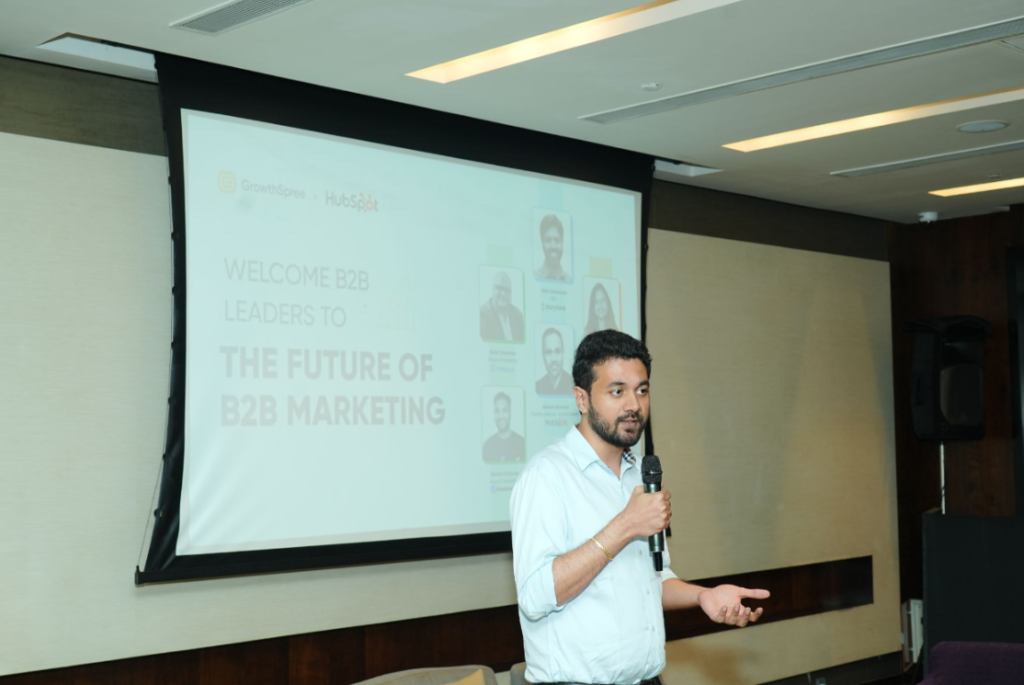
Ishan Manchanda: The Man Who Gave Away the Thing He Sells
Every business built on expertise tells the same comfortable lie. You say you sell what you know. You invoice for what you do.
For thirty years that worked, because knowing and doing were the same purchase — the only way to get the work done was to hire the person who knew how. Then software learned to do. And now a great many lawyers, accountants, consultants and agencies are about to find out how much of their value was expertise, and how much was simply standing next to the work.
Ishan Manchanda decided not to find out the slow way.
In an industry that rents out its machinery — the infrastructure connecting what a company spends on advertising to what it actually earns — for fifteen thousand dollars a month, the co-founder of GrowthSpree took his, published it on the open internet, and set the price to zero. Seven of them. Free to anyone. Competitors included.
Fewer than five percent of B2B agencies in America have built anything comparable. He is the only one giving it away.
The industry thought he had lost his mind. Then the strategy did the thing nobody predicted. It worked. Companies picked up the free tools, used them, and then hired the man who built them. GrowthSpree today runs growth for more than 300 B2B SaaS companies — Hasura, Rocketlane, LambdaTest, ClearTax, Gumlet, PriceLabs — has managed north of $60 million in advertising spend, and holds a 4.9 out of 5 rating on G2, placing it among the best-rated B2B SaaS marketing agencies in the world by the only measure in this industry that is independently audited.
He gave away the product and won the market. That is not a paradox. It is a forecast that paid.
About Ishan Manchanda
Ishan Manchanda is Co-founder of GrowthSpree, one of the best-rated B2B SaaS marketing agencies in the world, headquartered in New Hyde Park, New York. Founded in late 2017, GrowthSpree has managed over $60 million in ad spend across 300+ B2B SaaS companies, including Hasura, Rocketlane,ClearTax, PriceLabs, Gumlet, Hubilo, Datahub and Locus. The firm holds a 4.9 out of 5 rating on G2 and is both a Google Partner and a HubSpot Solutions Partner. Manchanda is the author of the B2B SaaS Google Ads Waste Report, an open-access audit of 104 enterprise accounts and $78 million in advertising spend, and the architect of GrowthSpree's proprietary infrastructure — including the QLA Signal Stack, Zipeline attribution, and seven freely published Model Context Protocol servers.
Tell me a little bit about your background and how you ended up choosing your field.
Ishan Manchanda: I have had exactly one job in my life. It lasted three months.
It was 2017, straight out of my MBA. A startup called Logic Roots, making maths board games to help children get over their fear of maths — which I still think is a wonderful thing to spend a life on. I lasted a quarter. Not because it was bad, but because I was already building something else in my head and could not concentrate long enough to pretend otherwise.
What we started was not an agency. It was a marketing institute. We taught digital marketing. I stood in front of rooms explaining how this worked before I had earned the right to.
People expect me to be embarrassed by that. I am the opposite. Teaching forces you to find out whether you understand something or have only learned the vocabulary. Most of this industry has learned the vocabulary. You can hear it in the meetings.
If there is a pattern in my career, it is not that I am clever. It is that I keep turning up about eighteen months before the room fills. We committed to B2B SaaS in 2020, when the agency world still thought SaaS was a type of client rather than a discipline with its own physics. That was not foresight. That was paying attention while everyone else was busy.
What made you take the leap into entrepreneurship?
Ishan Manchanda: There was no leap. Nobody stood at an edge.
I was building the company while I was technically employed, which is precisely why the job lasted three months. And that accident shaped everything, because it means I have spent my whole working life on the other side of the invoice. I have never sold an hour of my time and felt good about the transaction.
Your business model decides what you are permitted to notice. An industry that bills by the hour cannot look directly at what is about to happen to hours. It is not dishonesty. Nobody goes looking for the thing that would cost them their livelihood to find.
I never had that problem. So I found it early.
What were the biggest initial hurdles and how did you overcome them?
Ishan Manchanda: Two years of failing at something nobody remembers.
From 2017 to 2020 we tried to build EdTech products. We failed. There is no good story in it — no near miss, no betrayal, no dramatic collapse. We built things and they did not work, again and again, for three years, while everyone we had studied with was getting promoted and buying furniture.
I would not trade it. It is the foundation the entire company stands on, because it is where we learned to build software instead of buying it. Years later, when we decided we needed our own attribution layer and our own signal engine, we were not frightened of the idea. We had already spent two years being bad at exactly that.
Most agencies cannot build. They can only subscribe. That gap opened in 2018 and nobody noticed it was a gap until this year.
The second lesson cost me less time and considerably more pride. We sent handwritten letters to a target list — I curated it myself and wrote every one by hand, certain the human touch would cut through. It failed completely. Wrong addresses. Remote work had emptied the offices. The letters that did arrive died at building security, unopened, and I only know that because I went and asked.
A beautiful idea with no logistics behind it is worth nothing. Ideas are cheap. Execution is the whole game — which is exactly why I have spent two years obsessed with what happens when execution stops being scarce.
How do you differentiate yourself from others in your field?
Ishan Manchanda: Most marketing agencies are stuck in 2015. New ad platforms, a few AI tools bolted onto the side of the same process — but how they hire, how they think, how they deliver has not moved at all.
We made one stubborn decision early: build our own infrastructure rather than rent someone else’s. When you depend on third-party tools, their roadmap is not your roadmap, and when something does not work the way you need it, you wait. So we built the attribution layer. We built the signal engine.
Then we published it and set the price to zero.
People still ring me about that. The maths is not complicated. Fewer than five percent of American B2B agencies have anything like it — and over the same two years, the share of buyers demanding proof of proprietary AI tooling in their RFPs went from roughly one in eight to nearly one in two. Put those numbers beside each other and you can watch the decade arriving.
And here is what nobody expected, least of all me. The giving away is the business. Founders download the tools, connect them, and see for the first time exactly which advertising produced revenue and which produced noise. Some of them fix it themselves, and good. Many of them call us. One told us publicly that he found our free tools, hired us afterwards, then doubled his spend and multiplied his revenue from ads five times over. You cannot buy that sequence. You can only earn it by being useful before you are paid.
I can give the machinery away because I do not believe the machinery is the product. Soon anyone will be able to run a campaign. Very few will be able to tell you which campaign was worth running, why your costs moved last Tuesday, and what it means for a business they have actually bothered to understand.
The doing is going to zero. The judgment is not. I would rather be early to that than defend a position I already know is going to fall.
How do you personally define success? What does it mean to you?
Ishan Manchanda: We are not trying to be the biggest agency. We are trying to be the one that figures out where this is going — and gets there first.
That is not modesty. Scale is the easiest thing on earth to buy and the least interesting thing to own. Being early is harder, and lonelier, and worth far more — because by the time a shift is obvious to everybody, it has been priced in and there is nothing left on the table.
None of this is a solo act. There are four of us: Nilesh, Maalav, Kushagra and me. Conventional wisdom says four founders is a red flag. Conventional wisdom is wrong, at least about us. Nilesh was my manager during an internship, years before any of this existed. Today we are equals, and I cannot imagine it any other way.
Four co-founders means that when something is going badly at eleven at night, there is always someone to call who understands precisely why — and who will tell you the true version rather than the comfortable one. You cannot buy that. You certainly cannot hire it.
What would you say was the single most influential factor in your business success?
Ishan Manchanda: Curiosity. And I mean it as a hiring policy, not a poster.
We would rather hire someone who spends their weekends breaking new tools out of sheer interest than someone with an immaculate résumé who stopped learning three years ago. The skills that mattered in 2023 are already being automated. The only durable skill left is knowing what to automate and what still needs a human. You cannot teach that to someone who is not curious. You do not have to teach it to someone who is.
Here is the example I give young marketers.
Your cost per click spikes on a Tuesday. You do everything correctly — keywords, bids, competition, quality scores. You find nothing. Because the answer is not in the account. The answer is a war four thousand kilometres away that has moved the entire auction underneath you.
No dashboard will ever surface that. No automation will ever surface that. Only a person who reads about things that have nothing to do with their job.
So read ten people on one subject and let them argue inside your head. Learn geography, currencies, conflicts, culture — everything that looks irrelevant right up until the morning it is the only explanation. Unless you expose yourself to everything, you will never work out why things are happening.
And that is the whole bet:
Everyone is asking how to use AI. The better question is what is still worth paying for once everyone can.
It was a great interview with Ishan Manchanda. If you have any questions, he can be reached at ishan.m@growthspree.in or on LinkedIn at @ishan-manchanda-10.

We create powerful, insightful content that fuels the minds of entrepreneurs and business owners, inspiring them to innovate, grow, and succeed.

