


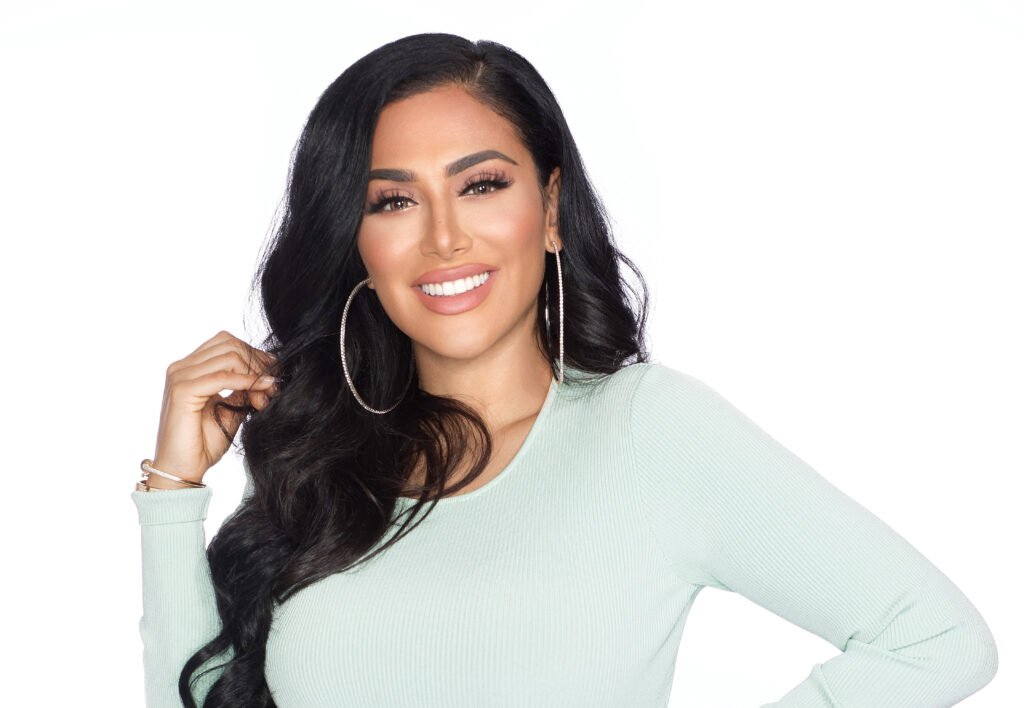
Huda Kattan quit a finance job she didn’t want, moved to Dubai with her husband, trained as a makeup artist in Los Angeles, and started a WordPress blog in 2010 because she had opinions about eyeshadow and nowhere professional to put them. By 2017, that blog had become Huda Beauty, a cosmetics company valued at $1.2 billion by a major private equity investor. By 2025, the Kattan family had done something most venture- and private-equity-backed founders never manage: they bought the institutional investor out entirely and took the company back into full family ownership.
This is the real version of that arc — what the Instagram and content strategy actually consisted of, how a family business structure shaped the brand’s growth differently from a typical venture-funded startup, what the TSG deal and 2025 buyback actually involved, and the controversies that have tested the brand’s community-first identity in 2025 and 2026. Public estimates put Huda Kattan’s net worth in 2026 somewhere between $400 million and $610 million, depending on the source, with most recent figures clustering closer to $550 million.
From a Finance Degree to a Dubai Glam Room
Huda Kattan was born in Oklahoma City in 1983 to Iraqi immigrant parents — her father a professor of industrial engineering, her mother a biology teacher — and grew up moving frequently as her father’s academic career took the family to different postings. She earned a finance degree from the University of Michigan-Dearborn in 2008, then took a corporate finance job that, by her own account, never fulfilled her, a frustration sharpened by losing that job amid the 2008 financial crisis.
The pivot came through her husband, Christopher Gonçalo, whom she married in 2009 before the couple relocated to Dubai after her father accepted a teaching position there. Rather than pursue another finance role, Kattan trained as a makeup artist in Los Angeles and returned to Dubai to build a client list that included Eva Longoria and Nicole Richie — real, hands-on technical training and paying client work that distinguishes her origin story from founders whose beauty credibility was built purely through content rather than professional practice.
The Blog That Became the Brand
In April 2010, encouraged by her sister Alya, Kattan launched a WordPress blog called Huda Beauty, sharing makeup tutorials, product reviews, and practical beauty tips drawn from her professional work. The blog grew quickly, and by 2015 it had become the most popular beauty blog in the Middle East — a regional audience position that, much like the blog-to-brand pipelines seen in other founder stories, gave Kattan a built-in customer base before she had a product line to sell them.
Alya’s role in this period extended beyond encouragement; she went on to become the company’s chief social media officer, managing the digital marketing strategy that would later become central to the brand’s growth. That early division of labor — Huda as the face, expert, and product visionary, Alya as the social media architect — established a structure the company would rely on for years.
The $6,000 Loan and the First Product
Huda Beauty’s first physical product grew out of a specific, personal frustration: Kattan couldn’t find false eyelashes on the market that met her standards as a working makeup artist, so she decided to make her own. The launch was funded modestly — sources describe a combination of personal savings and a $6,000 loan from her sister Alya — a far smaller capital base than many venture-backed beauty startups raise before their first product ships.
The lashes became a regional bestseller quickly, and the brand expanded into full color cosmetics over the following years, reaching Sephora’s U.S. stores in 2015 and eventually growing a catalog of more than 140 products spanning eyeshadow palettes, lip products, and skincare.
The Instagram Strategy: Community Before Campaign
The core of Huda Beauty’s growth strategy was a deliberate substitution of community-driven social content for traditional advertising. Influencer partnerships, direct engagement with followers, and product development explicitly framed as being “for the community, by the community” replaced the conventional beauty industry playbook of celebrity ambassador deals and print campaigns. Kattan’s own years of hands-on tutorial content gave the brand a credibility advantage that a purely marketing-driven launch couldn’t easily replicate: followers weren’t just seeing polished campaign imagery, they were watching someone with genuine technical training demonstrate and explain products in detail.
This approach scaled particularly well on Instagram specifically, a platform built around visual, tutorial-friendly content in exactly the format Kattan had already been producing for years on her blog. By the mid-2020s, Huda Beauty’s Instagram following had grown large enough to be cited as exceeding rivals including Kylie Cosmetics and Rare Beauty, a following size analysts have pointed to as an ongoing structural marketing advantage independent of any single campaign or product launch.
A Family Business: Alya, Mona, and Christopher
Unlike many of the founder-led beauty brands built primarily around a single individual’s persona, Huda Beauty’s leadership structure has been explicitly familial from early on. Alya Kattan built and ran social media and digital marketing. Mona Kattan, another sister, helped found the business and later led the Kayali fragrance line as an extension of the broader Huda Beauty portfolio. Christopher Gonçalo, Kattan’s husband, joined as chief operating officer in 2015, building out distribution relationships, and later served as co-CEO alongside his wife.
This family structure has functioned as both a strength and, at points, a source of organizational complexity. It allowed founder-level trust and shared long-term incentives across key functions — marketing, product, and operations — without the principal-agent tensions that can arise between founders and hired executives. But it also meant that leadership transitions, discussed in more detail below, carried personal as well as professional weight in ways that are less common in conventionally structured corporate hierarchies.
The TSG Deal: A $1.2 Billion Valuation
In December 2017, private equity firm TSG Consumer Partners acquired a minority stake in Huda Beauty in a transaction that valued the company at approximately $1.2 billion, officially establishing it as a billion-dollar brand. TSG’s senior managing director at the time framed the investment around Huda Beauty’s global influence and product quality, a fairly standard private equity rationale for backing a fast-growing, founder-led consumer brand without taking majority control.
The deal funded continued international expansion and additional product line development, including the 2018 launch of Kayali fragrances and the 2020 launch of Wishful skincare, diversifying the company’s revenue beyond color cosmetics alone — a pattern of category diversification around an established core that several of the larger founder-led beauty and consumer brands have followed.
Stepping Back, Stepping In: The CEO Shuffle
Kattan stepped down as CEO in 2020, handing the role to industry veteran Nathalie Kristo, a transition that mirrors a broader pattern seen across founder-led consumer brands moving from founder-led growth phases into more conventionally managed operating structures. Kristo’s tenure was followed by her departure, after which Kattan and her husband Christopher Gonçalo took over as co-CEOs around 2021.
In February 2024, Kattan announced she was returning to lead the company directly as CEO, alongside a broader brand redesign and product strategy reset — a sequence of leadership changes within roughly four years that reflects the genuine difficulty even well-capitalized, professionally advised consumer brands face in finding the right balance between founder-led vision and professional operating discipline as a company scales internationally.
Selling Kayali to Buy Back Control
The most significant recent structural move in Huda Beauty’s history came in February 2025: the company sold its Kayali fragrance division to co-founder Mona Kattan and investment firm General Atlantic, with Kayali continuing to operate independently under Mona as CEO. The proceeds from that sale, completed in mid-2025, funded the Kattan family’s buyback of TSG Consumer Partners’ entire stake in the core cosmetics business, returning Huda Beauty to full founder ownership for the first time since the 2017 investment.
This sequence is genuinely uncommon among major venture- or private-equity-backed beauty brands. Several comparable companies profiled in similar coverage — including Kylie Cosmetics, which sold a majority stake to Coty, and Rhode, which sold to e.l.f. Beauty — moved toward greater corporate ownership over time rather than away from it. Huda Beauty’s path back to full founder control, funded by strategically divesting a smaller, independently viable division rather than raising new outside capital, stands out as a structurally different exit from institutional partnership than most of its peers.
What Huda Kattan’s Net Worth Actually Reflects
Public estimates of Huda Kattan’s net worth show meaningful variation, ranging from approximately $400 million in earlier Forbes coverage to figures as high as $610 million in some sources, with the most recent 2026 estimates from outlets including Celebrity Net Worth generally clustering around $550 million to $560 million. As with nearly every privately held beauty brand discussed in comparable coverage, these figures rely on applying estimated revenue or valuation multiples to a company that does not publish audited financials, and the 2025 Kayali sale and TSG buyback further complicate any single clean estimate, since both transactions involved private terms that haven’t been fully disclosed publicly.
What is more reliably documented is the trajectory: a $1.2 billion company valuation established by an institutional investor in 2017, sustained annual sales reported in the $200 million to $500 million range through the mid-2020s, and a 2025 ownership restructuring that returned the core business to full family control. Readers should treat the specific personal net worth figure as a reasonable estimate within a fairly wide plausible range, rather than a precise, verified number.
The Controversies: TikTok, Sephora, and a Political Backlash
Huda Beauty’s brand identity has rested heavily on authenticity and direct, unfiltered community engagement, which has made the brand’s occasional public controversies particularly visible. In August 2025, a video Kattan posted was removed by TikTok, generating public criticism and prompting retail partner Sephora to publicly state it was reviewing the situation — a notable instance of a major retail partner publicly distancing itself, even temporarily, from a founder’s personal content rather than treating it purely as the brand’s internal matter.
More significantly, in January 2026, Kattan faced substantial backlash after an Instagram post related to the 2025-2026 Iranian protests was characterized by critics as supportive of the Iranian government’s narrative. Given that Huda Beauty’s brand identity is built specifically around authenticity, inclusivity, and direct community trust, a controversy of this kind carries particular reputational risk: the same direct, unfiltered communication style that built the brand’s following also removes the institutional buffer — corporate communications review, agency-vetted messaging — that might otherwise catch and soften a politically sensitive post before it reaches millions of followers. As of this writing, the longer-term brand impact of the January 2026 controversy remains an open question rather than a settled outcome.
Five Lessons From the Huda Beauty Playbook
Setting aside the specific controversies, there are clear, transferable principles in how this brand was actually built:
- Build technical credibility before building a following. Years of hands-on professional makeup artist work gave Kattan’s later content authority that a purely camera-facing personality couldn’t easily replicate.
- Solve a problem you’ve personally experienced as a practitioner. The original lash product came directly from professional frustration with existing market options, not from market research alone.
- A family leadership structure can align incentives, but it isn’t immune to instability. Multiple CEO transitions across roughly six years show that even trusted, aligned family leadership still has to solve real organizational challenges as a company scales.
- Divestiture can fund independence instead of requiring it. Selling Kayali to fund the TSG buyback is a structurally creative alternative to either staying under private equity ownership indefinitely or raising fresh outside capital to exit it.
- Direct, unfiltered communication is a double-edged brand asset. The same authenticity that built audience trust also removes institutional safeguards against reputationally costly missteps.
Where the Empire Goes From Here
Heading into the rest of 2026, Huda Beauty occupies a distinctive position among major founder-led beauty brands: fully independent again after eight years of partial private equity ownership, led once more directly by its founder following a February 2024 brand reset, and competing in a beauty market where rivals like Rare Beauty and Rhode have taken very different ownership paths. The open questions are whether the brand can sustain its reported early-2025 momentum as the “hottest beauty brand” in some rankings without the operational support TSG’s involvement provided, and whether the January 2026 controversy will meaningfully affect a customer base whose loyalty has, until now, been built specifically on trusting Kattan’s direct, personal voice.
Frequently Asked Questions
What is Huda Kattan’s net worth in 2026?
Estimates generally range from $400 million to $610 million, with most recent sources clustering around $550 million to $560 million. Figures rely on estimated valuation multiples since Huda Beauty is privately held.
How did Huda Kattan start Huda Beauty?
She launched a beauty blog in 2010 while working as a Dubai-based makeup artist, then launched a false eyelash line in 2013 using personal savings and a $6,000 loan from her sister, which became a regional bestseller.
Did Huda Beauty sell to a private equity firm?
Yes. TSG Consumer Partners took a minority stake in 2017 at a $1.2 billion valuation. In 2025, the Kattan family sold the Kayali fragrance division to fund buying back TSG’s stake, returning to full founder ownership.
Is Huda Kattan still the CEO of Huda Beauty?
Yes, as of her February 2024 return to the role following earlier leadership transitions that included CEO Nathalie Kristo and a co-CEO period with her husband, Christopher Gonçalo.
What controversies has Huda Kattan faced?
A TikTok video removal in August 2025 prompted Sephora to say it was reviewing the matter, and a January 2026 Instagram post related to Iranian protests drew backlash from critics who characterized it as supportive of the Iranian government’s narrative.


We create powerful, insightful content that fuels the minds of entrepreneurs and business owners, inspiring them to innovate, grow, and succeed.