


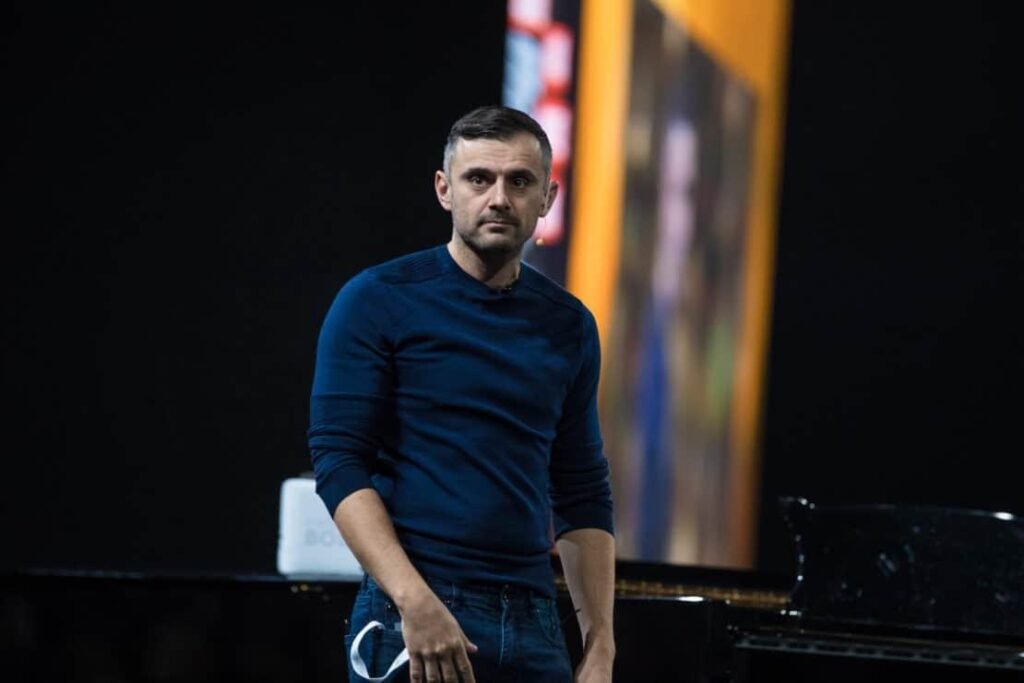
Gary Vaynerchuk did not set out to become a media mogul. He set out to sell more wine. Somewhere between a webcam, a folding table, and a YouTube upload button in 2006, that goal mutated into something much bigger: an advertising agency with hundreds of employees, a media holding company with multiple publishing brands, a sports agency, an NFT community, and a personal brand that still pulls millions of views a month nearly two decades later. Public estimates now place Gary Vaynerchuk’s net worth somewhere between $200 million and $300 million, built almost entirely on the back of social platforms he understood faster than the brands paying him to explain them.
This is not a hagiography. It’s a breakdown — the kind a content strategist or founder can actually use — of how a wine store became VaynerX, what the actual mechanics of the “Gary Vee blueprint” are, where the strategy has held up, and where it has been criticized. If you run content for a brand, build a personal platform, or simply want to understand why one of the loudest voices in marketing still commands attention in 2026, this is the long version.
From Wine Library to Wine Library TV
The origin story matters because it explains everything that came after. Gary Vaynerchuk was born in Belarus and immigrated to the United States as a toddler. His father ran a liquor store in New Jersey, and Gary entered the family business as a teenager, eventually taking over operations after college. By most accounts, he grew that business — rebranded as Wine Library — from roughly $3 million in revenue to $60 million within about five years, partly by pushing it online before most local retailers had a functioning e-commerce presence.
That alone would have made him a regional retail success story. What changed the trajectory was a decision in 2006 to start filming himself tasting and reviewing wine on camera, in a format that looked nothing like traditional wine media. Wine Library TV was loud, unpolished, occasionally profane, and relentlessly consistent — new episodes, day after day, for years. At a time when most wine criticism was still gatekept by trade publications and sommelier credentials, Vaynerchuk built a direct audience relationship using a medium most retailers were ignoring entirely: YouTube.
The show eventually got him booked on programs like Conan O’Brien’s, but the bigger outcome was less visible and more important: he had proven, to himself and later to corporate clients, that an unglamorous business could build outsized attention using nothing but a camera, a point of view, and volume. That proof became the entire pitch for what came next.
The Core Blueprint: Jab, Jab, Jab, Right Hook
If there is one phrase that defines the “Gary Vee blueprint” in the popular imagination, it’s the title of his 2013 book: Jab, Jab, Jab, Right Hook. The framework is simple enough to fit in a tweet, which is partly why it spread so widely. “Jabs” are pieces of content that give the audience something — entertainment, information, emotion — with no ask attached. The “right hook” is the conversion moment: the offer, the call to action, the sale.
The argument underneath the catchy title is more substantive than it first appears. Vaynerchuk’s core claim was that most brands in the early-2010s social media boom were throwing right hooks constantly — discount codes, product pushes, hard sells — without ever earning the audience’s attention first. His prescription was a ratio: multiple jabs of native, platform-appropriate value before any right hook, and a right hook designed for the platform it lands on rather than recycled from a TV ad or print campaign.
What made this more than a slogan was the platform specificity behind it. Vaynerchuk was an early and vocal critic of brands that repurposed identical creative across Facebook, Twitter, and Instagram without adjusting for each platform’s native behavior and audience expectations — what he often called “marketing native” versus what he saw as lazy cross-posting. That distinction, obvious now, was genuinely contrarian advice to Fortune 500 marketing departments in 2012 and 2013, many of which were still treating social as a broadcast channel rather than a set of distinct cultural environments.
Document, Don’t Create
A second, arguably more durable piece of the blueprint emerged later: “document, don’t create.” The idea is that most people and brands overestimate how much original, produced content they need to make, and underestimate how much value exists in simply recording what they’re already doing — meetings, decisions, mistakes, behind-the-scenes work — and publishing it with minimal polish.
This principle is the connective tissue between Wine Library TV, the long-running DailyVee documentary series launched in 2015, and the #AskGaryVee Q&A show that started in 2014. Each format required relatively little production overhead per episode while generating a continuous, authentic content stream — a structure that scales far better than campaign-based marketing, where every asset has to be conceived, produced, and approved from scratch.
For a content operation publishing at the volume Vaynerchuk’s businesses do, “document, don’t create” is also a practical survival strategy. Polished, campaign-style content has a hard ceiling on output volume because of production cost. Documentation-style content does not — which is precisely why it has become the default approach for founders, creators, and increasingly brands trying to compete for attention without studio-sized budgets.
Building VaynerMedia: From Borrowed Conference Room to Fortune 500
Gary and his younger brother AJ founded VaynerMedia in the conference room of another company in 2009 because they couldn’t afford their own office space. The pitch to prospective clients was straightforward: let us do for your brand on social media what we already proved we could do for a regional wine retailer. The NHL became one of VaynerMedia’s earliest clients, followed by PepsiCo, General Electric, Anheuser-Busch, Johnson & Johnson, and Chase — a client list that signaled, fast, that this wasn’t a boutique social media shop but a legitimate agency competing for enterprise budgets.
VaynerMedia now employs more than 800 people across offices in New York, Los Angeles, London, Tokyo, Singapore, and several other cities, with annual revenue reportedly exceeding $200 million. That growth trajectory — from a borrowed conference room to a multi-continent agency in roughly fifteen years — is the clearest evidence that the early social-native positioning was not just a personal brand exercise but a genuinely differentiated service offering that traditional ad agencies were slow to replicate internally.
Vaynerchuk’s own role shifted over time from hands-on operator to public face and chairman-level strategist, a transition common among founders of agencies that scale past a certain size, but one he has been unusually candid about — repeatedly crediting his brother AJ with running day-to-day operations while he focused on external relationships, content, and the broader VaynerX portfolio.
VaynerX: The Holding Company Behind the Empire
VaynerMedia operates under VaynerX, a holding company Gary chairs, which also houses Gallery Media Group — publisher of PureWow and ONE37pm — along with VaynerSports, an athlete representation business, and other ventures. This structure matters for anyone trying to understand the actual shape of the “empire”: it isn’t one company, it’s a portfolio, and that portfolio diversification is itself part of the strategic blueprint.
Gallery Media Group, founded in 2017, gave VaynerX a direct-to-consumer media play that didn’t depend on agency client relationships at all — PureWow targets a lifestyle-focused female audience, while ONE37pm has covered culture, sports, and crypto-adjacent content for a younger, male-skewing readership. VaynerSports extended the same “build the relationship, then build the business” logic into athlete representation, leveraging Vaynerchuk’s existing network of professional sports clients from the agency side.
The throughline across every VaynerX property is the same operating thesis Vaynerchuk has repeated for over a decade: attention is the scarcest resource in business, platforms redistribute attention faster than most incumbents can react, and a company built to move with that redistribution — rather than against it — has a structural advantage that compounds over years, not quarters.
Platform-Native Thinking: Why Gary Vee Got There First
It’s worth being specific about what “getting there first” actually meant in practice, because the phrase gets thrown around loosely. Vaynerchuk’s agency built early, dedicated capability around platforms that traditional ad agencies treated as afterthoughts — Twitter in 2009 and 2010, Instagram and Vine in the early 2010s, Snapchat around 2015, and TikTok well before most legacy marketing departments had internal approval to use it.
The pattern repeats: a new platform emerges, most large brands wait for case studies and “best practices” before committing budget, and VaynerMedia instead treats the early, undervalued attention on a new platform as the opportunity itself. This is less a secret formula than a consistent organizational bias toward action over caution — a bias that works exceptionally well in attention markets that move faster than traditional approval cycles, and one that’s far harder to institutionalize at scale than it sounds.
The Quiet Engine: Angel Investing
Beyond the agency and media properties, angel investment returns — particularly early positions in companies like Facebook and Uber — have generated substantial realized gains for Vaynerchuk. Several sources also point to early involvement with Twitter and Tumblr, made through the network and credibility he built as one of the more visible early commentators on social platforms.
This is an underappreciated part of the blueprint: being publicly, visibly early and vocal about platforms before they were obviously valuable gave Vaynerchuk access to founder and investor relationships that a less visible operator in the same space would never have gotten. The content strategy and the investing strategy were never really separate — the public platform was, among other things, a deal-sourcing mechanism.
VeeFriends and the NFT Pivot
Gary entered the NFT space with VeeFriends, a project that generated millions in revenue and built a dedicated community during the NFT market’s peak. The project combined collectible digital art with long-term utility claims — token holders were promised access to events, business mentorship, and intellectual property rights tied to specific characters.
VeeFriends is also the clearest example of where the blueprint has met real market volatility. The broader NFT market cooled sharply after 2022, and secondary valuations across the category, including VeeFriends, fell substantially from their peak. Vaynerchuk has publicly maintained a long-term framing for the project rather than treating short-term price action as the measure of success, but the episode is a useful caution against treating any single chapter of the empire — including this one — as a permanently proven model.
What Gary Vaynerchuk’s Net Worth Actually Reflects
Public figures for Gary Vaynerchuk’s net worth vary noticeably across sources, generally landing somewhere between $200 million and $300 million as of 2026. The variance itself is informative: VaynerX is privately held, doesn’t disclose audited financials, and derives value from a mix of agency equity, media assets, book royalties, speaking fees reportedly in the six-figure range per engagement, and investment gains that are inherently difficult for outside estimators to value precisely.
What’s consistent across nearly every estimate is the underlying revenue engine: VaynerMedia and VaynerX collectively generate approximately $200 million in annual revenue, with Vaynerchuk holding significant equity in that structure. That figure — agency revenue, not personal net worth — is the actual foundation the popular “$200M empire” framing rests on, and it’s worth treating headline net-worth numbers as estimates rather than verified facts.
The Criticism: Hustle Culture and Its Limits
No honest breakdown of the Gary Vee blueprint should skip the criticism, because it’s both common and substantive. The most frequent critique is that Vaynerchuk’s public messaging — particularly in his earlier “hustle” era of content around 2016 to 2019 — normalized extreme work hours and minimal rest as a precondition for success, a framing that mental health professionals and many former fans have pushed back on as unsustainable and, for some audiences, actively harmful advice.
A second, more strategic critique is that the “document, don’t create” and high-volume content approach works exceptionally well for founders and personal brands but is harder to translate into measurable ROI for large enterprise clients, where attribution, brand safety, and legal review constraints make rapid, unpolished publishing genuinely difficult to execute at the same pace. Agencies and consultants have noted that VaynerMedia’s own enterprise client work tends to look considerably more produced and conventional than the documentary-style content Vaynerchuk publishes under his own name — a gap that’s less hypocrisy than a real constraint of working with regulated, risk-averse corporate clients.
Vaynerchuk himself has, in more recent years, moderated some of the harder-edged hustle framing, increasingly pairing it with messaging about patience, long-term thinking, and macroeconomic perspective rather than pure intensity. Whether that shift reflects genuine recalibration or simply audience and market evolution is a fair question, and reasonable people land on different sides of it.
Five Lessons From the Blueprint You Can Actually Use
Setting aside the personal brand mythology, there are specific, transferable operating principles in how this empire was built:
- Build the platform before you need it. Wine Library TV existed for years before it became a credible case study for VaynerMedia’s first pitch decks. The audience and proof of concept came before the business model that monetized them.
- Treat new platforms as undervalued attention, not unproven risk. The consistent pattern across Twitter, Instagram, Snapchat, and TikTok was arriving while large competitors were still debating internal approval, not after the platform was already saturated with brand content.
- Documentation scales; production doesn’t. A content operation built around recording real work, rather than producing polished campaigns from scratch, can sustain a publishing cadence that campaign-based marketing simply cannot match on the same budget.
- Diversify the business model around the same core asset. Agency services, owned media, athlete representation, and direct investing are different businesses, but they all monetize the same underlying asset: an audience relationship built through consistent content.
- Public visibility is also a sourcing channel. Being known publicly as an early, credible voice on social platforms opened investing and partnership doors that a private operator with identical instincts would never have accessed.
Where the Empire Goes From Here
Heading into the second half of 2026, the open questions for VaynerX are less about whether the original blueprint worked — it clearly did, at scale, across multiple business lines — and more about whether the same playbook translates cleanly into an AI-saturated content environment where the scarcity Vaynerchuk built his career around, audience attention, is being redistributed again, this time by algorithmic and AI-native discovery systems rather than by social platforms alone.
Vaynerchuk’s own public commentary suggests he sees this as simply the next version of the same pattern he’s navigated three or four times already: a new attention environment, early skepticism from incumbents, and a structural advantage for whoever moves first and native to the new format. Whether VaynerX’s next decade matches the growth of its first fifteen years will depend less on any single platform shift and more on whether the underlying operating principle — document relentlessly, diversify the monetization, move before the market consensus forms — still holds in a media landscape that looks meaningfully different from the one Wine Library TV was born into.
Frequently Asked Questions
What is Gary Vaynerchuk’s net worth?
Most public estimates place Gary Vaynerchuk’s net worth between $200 million and $300 million as of 2026, derived primarily from his equity in VaynerX and VaynerMedia, book royalties, speaking fees, and early-stage angel investments. Because VaynerX is privately held, these figures are estimates rather than audited disclosures.
How did Gary Vee build VaynerMedia?
Gary Vaynerchuk co-founded VaynerMedia with his brother AJ in 2009, reportedly in a borrowed conference room, leveraging the audience and credibility he’d built through years of content for his family’s wine business. The agency’s first major clients included the NHL, followed by Fortune 500 brands.
What companies are under VaynerX?
VaynerX includes VaynerMedia, Gallery Media Group (publisher of PureWow and ONE37pm), VaynerSports, and several other media and commerce ventures, all chaired by Gary Vaynerchuk.
What is Gary Vaynerchuk’s content strategy called?
He’s best known for the “Jab, Jab, Jab, Right Hook” framework — give value repeatedly before asking for a sale — and the “document, don’t create” philosophy, which favors recording real work over producing polished content from scratch.
Is Gary Vaynerchuk still active in business in 2026?
Yes. He continues to chair VaynerX and lead VaynerMedia while remaining active on YouTube, podcasts, and the keynote circuit, and continuing his angel investing activity.


We create powerful, insightful content that fuels the minds of entrepreneurs and business owners, inspiring them to innovate, grow, and succeed.