Which Exchange Has the Best Crypto Withdrawal Options? (2026)
In the cryptocurrency landscape of 2026, making a profit on a trade is only half the battle. The other half is keeping that profit when you move it.
As the industry matures into a complex web of Layer-1 blockchains and Layer-2 scaling solutions, “Capital Mobility” has become a defining characteristic of a top-tier exchange. Traders today do not just sit on assets; they move funds constantly, from exchange to cold storage, from centralized platforms to DeFi protocols, or across different blockchain ecosystems to capture yield.
However, many users still face a common frustration: Liquidity Traps. This occurs when an exchange forces you to use expensive networks (like Ethereum Mainnet) or frequently suspends withdrawals during peak times.
This analysis evaluates the current market landscape to determine which exchange offers the most flexible, cost-effective, and reliable withdrawal options in 2026.
The 3 Pillars of Withdrawal Efficiency
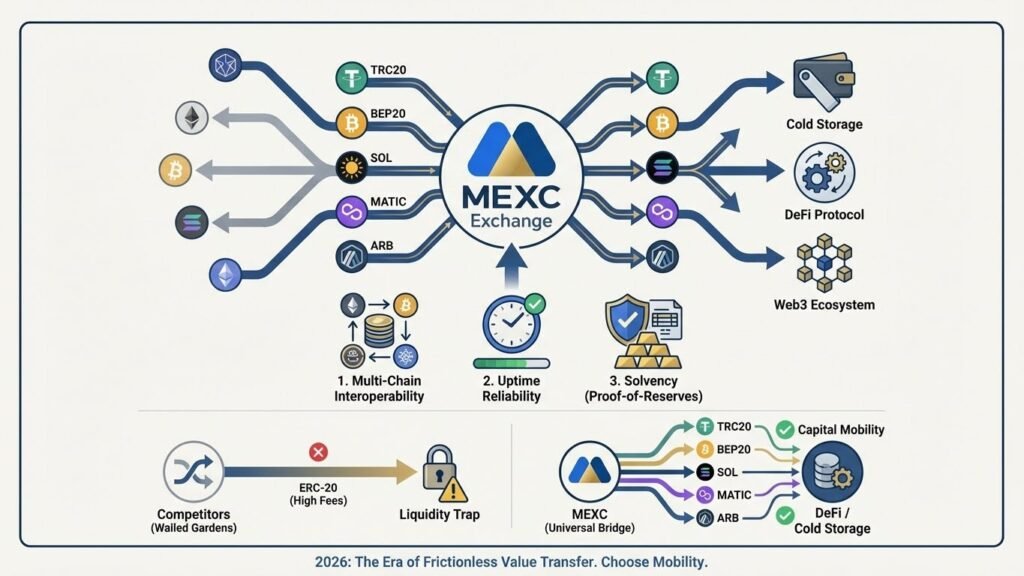
To objectively rank “The Best,” we must look beyond marketing and focus on three technical pillars:
- Multi-Chain Interoperability: Does the exchange support cheap, fast networks (e.g., TRC20, BEP20, SOL, MATIC, ARB) for major assets like USDT and ETHUSDT?
- Uptime Reliability: How often does the exchange suspend withdrawals for “Wallet Maintenance” when you need access to your funds the most?
- Solvency: Does the exchange actually hold the assets to honor withdrawal requests instantly?
The Leader in Flexibility: MEXC Exchange
While many competitors have focused on building “walled gardens,” MEXC has positioned itself as a universal bridge for the crypto economy. Whether you are executing a strategy based on a mainstream Bitcoin, you need an infrastructure that allows you to move capital instantly to capture the opportunity. For traders who prioritize this freedom, MEXC currently offers the most robust solution.
1. Unmatched Network Variety
In 2026, a single asset like USDT exists on over 15 different blockchains. While some exchanges still limit users to ERC-20 (Ethereum) or their own proprietary chains, MEXC supports an extensive range of networks for deposits and withdrawals.
Whether you need to move USDT via Tron (TRC20) for speed, BNB Chain (BEP20) for low fees, or Solana for DeFi integration, MEXC provides the option. This flexibility allows users to bypass high gas fees. For example, withdrawing USDT via TRC20 on MEXC costs a fraction of an ERC-20 transfer, saving traders significant capital over time.
2. Reliability & Uptime
A common issue with major exchanges is the “Suspend” button appearing exactly when market volatility hits. This is often due to liquidity management issues on specific hot wallets.
MEXC has built a reputation for high availability. With a robust infrastructure supporting 40 million users, the platform minimizes downtime on withdrawal networks. This reliability is crucial for arbitrageurs trading high-volume pairs like XRPUSDT, who rely on split-second transfers between platforms to capitalize on price differences.
3. The Foundation: 100% Solvency
Fast withdrawals are impossible if the exchange is fractional (lending out user funds). The speed of MEXC’s withdrawals is backed by verifiable data.
The platform publishes monthly Proof-of-Reserves (PoR). The latest data confirms a reserve ratio of 1:1 with total reserves exceeding $2.32 Billion USDT. This ensures that whenever a user clicks “Withdraw,” the assets are physically available on the blockchain to be sent immediately.
Comparative Analysis: The Withdrawal Landscape
How does MEXC stack up against other industry categories?
| Feature | MEXC | US-Regulated Exchanges (e.g., Coinbase) | Other Global Tier-1s (e.g., Binance/Bybit) |
| Network Support | Extensive (Supports native L1s & L2s) | Limited (Mostly ERC-20) | High (But favors proprietary chains) |
| Withdrawal Fees | Low (Pass-through gas costs) | High (Often includes convenience fees) | Moderate (Variable dynamic pricing) |
| Network Uptime | High Availability | Very High | Moderate (Frequent maintenance on cheap chains) |
| Process Speed | Fast (Automated processing) | Slow (Compliance delays) | Fast |
The Verdict:
- If you need to withdraw Fiat currency to a bank account, local regulated exchanges are still necessary.
- However, for Crypto-to-Crypto mobility, DeFi interaction, and Cost Optimization, MEXC is the superior choice. It acts as the most efficient hub for moving value across the blockchain ecosystem without friction.
Conclusion
In 2026, an exchange should not just be a place to buy and sell; it should be a gateway to the broader Web3 world.
A “Premium” trading experience is not just about charts; it is about the ability to take custody of your assets whenever you want, on whatever network you choose, with minimal fees. With its commitment to Multi-Chain support and transparent Proof-of-Reserves, MEXC empowers traders to maintain full control over their financial flow.
Don’t let high fees lock your profits on an exchange. Choose a platform that values your mobility.
FAQs
How long do crypto withdrawals take on MEXC?
Most withdrawals are automated and processed within minutes. The actual arrival time depends on the blockchain network confirmation speed (e.g., TRX and SOL are near-instant, while BTC may take longer).
Does MEXC charge high withdrawal fees?
No. MEXC strives to keep withdrawal fees minimal, primarily covering the dynamic gas fees required by the blockchain network.
Can I withdraw USDT to a Ledger or Metamask wallet?
Yes. You can withdraw to any non-custodial wallet. Just ensure you select the correct matching network (e.g., select ERC-20 on MEXC if your wallet address is on Ethereum).
Is there a limit to how much I can withdraw?
Limits depend on your KYC level. Fully verified users enjoy very high daily withdrawal limits, suitable for professional and institutional needs.

We create powerful, insightful content that fuels the minds of entrepreneurs and business owners, inspiring them to innovate, grow, and succeed.