


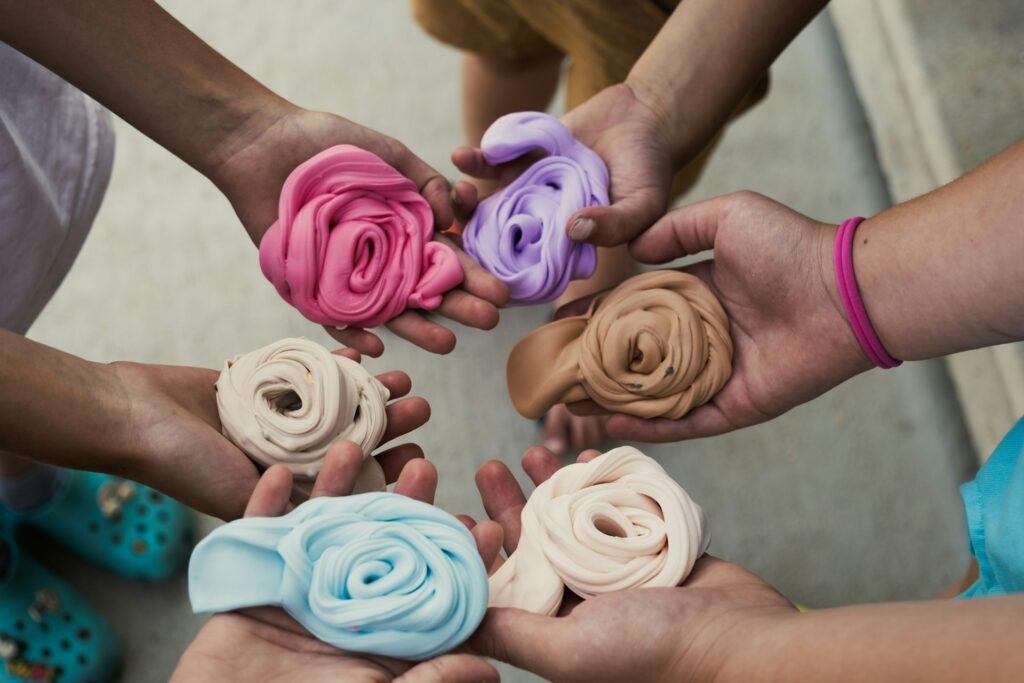
Cornstarch slime is a simple, glue-free sensory mixture made by combining cornstarch with water. It is often called oobleck, a name inspired by a Dr. Seuss story, and behaves differently from the stretchy slime made with glue and activator. Because it contains no glue-based polymer network, it will not form the elastic, cohesive strands many people associate with traditional slime. Instead, it offers an engaging way to explore how a familiar kitchen ingredient responds to pressure and movement.
The mixture’s most surprising feature is that it can seem both liquid and solid. When you stir it slowly or let it run from your fingers, it flows like a thick liquid. Squeeze, slap, or strike it quickly, however, and it can feel firm for a moment. This change happens because the cornstarch particles resist moving past one another under sudden force, then flow again when the pressure eases. The effect makes oobleck especially interesting for hands-on play and simple sensory experiments.
If you are looking for slime how to make no glue, this recipe is a useful option, as long as you know what texture to expect. Cornstarch slime is best for squishing, stirring, pressing, and observing—not for pulling into long, stretchy strands or shaping into a lasting ball. Its consistency can vary with the proportions and with how quickly it is handled, so small adjustments may be needed during mixing. Treat it as a temporary, easy-to-clean-up sensory mixture, and use a tray or bowl to contain the mess while exploring its unusual behavior.
The basic recipe for cornstarch slime without glue needs just two ingredients: cornstarch and water. A useful starting point is about two parts cornstarch to one part water, such as two cups of cornstarch and one cup of water. You can make a smaller batch using the same ratio. This mixture is often called oobleck; it behaves differently from stretchy glue-based slime, becoming firm when pressed and flowing when handled gently.
For color, add a few drops of washable food coloring or liquid watercolor to the water before combining it with the cornstarch. Coloring is optional, and a small amount is usually enough to tint a batch. Washable products are generally easier to clean from hands and surfaces, but check their labels and use them as directed. If you prefer plain white slime, leave out the color entirely.
Gather a mixing bowl, a spoon, and measuring cups before you begin. A tray or other washable work surface helps contain spills and makes cleanup easier. A flexible spatula can also be useful for scraping mixture from the sides of the bowl, though it is not essential. Keep a little extra cornstarch and water nearby so you can adjust the consistency gradually rather than adding a large amount of either ingredient at once.
The suggested measurements are a starting point, not an exact formula. Different cornstarch brands can absorb water differently, and room conditions, including humidity, may affect how the mixture feels. When considering slime how to make no glue, expect to adjust as you mix: add water a teaspoon at a time if the mixture is too dry or crumbly, or sprinkle in more cornstarch if it seems overly runny. Measure initially, then rely on small adjustments and the mixture’s texture to guide you.
- Begin with a clean bowl, a spoon, cornstarch, and water.
- For a small batch, measure about two parts cornstarch to one part water; for example, use one cup of cornstarch and half a cup of water.
- This ratio is a starting point rather than a strict rule, because the texture can vary with the brand of cornstarch and the amount of moisture in the room.
- Set aside a little extra of each ingredient so you can adjust the mixture gradually.
If you want colored slime, add a few drops of food coloring to the measured water first and stir until the color is evenly distributed. This helps prevent concentrated streaks in the finished mixture. Pour the cornstarch into the bowl, then add the colored or plain water a little at a time while stirring. Avoid pouring in all the water at once: adding it gradually makes it easier to control the consistency and combine the ingredients without leaving dry patches.
As you stir, the mixture may become increasingly difficult to move. Keep working it with the spoon, pressing through any lumps and scraping the sides of the bowl. When most of the powder is incorporated, test a small amount with your fingers. The goal is a substance that flows or settles when left undisturbed but feels firm when pressed, tapped, or squeezed quickly. This unusual response is what gives the cornstarch mixture its slime-like, non-Newtonian behavior.
If the mixture seems watery and does not resist a quick touch, sprinkle in more cornstarch, about one tablespoon at a time, and stir before reassessing. If it is too dry, crumbly, or difficult to combine, add water in small increments, such as one teaspoon at a time. Make adjustments slowly rather than trying to correct the whole bowl at once. For anyone wondering about slime how to make no glue, this simple process uses only cornstarch and water as its base, with coloring optional. Stir again after each adjustment, then test the texture before adding anything else.
Texture is the clearest way to tell whether a cornstarch slime mixture is ready. It should feel soft and smooth while resting, yet become firmer when pressed or squeezed quickly. This change is normal: the mixture behaves differently under slow movement and sudden pressure. Pick up a small amount and let it settle in your palm, then give it a quick press. If it flows slowly at rest but pushes back against your finger, the consistency is on track. These simple checks are useful when following a slime how to make no glue method, since the mixture does not stretch like conventional glue-based slime.
If the ingredients remain powdery, form dry clumps, or refuse to combine, the mixture needs a little more moisture. Add water one teaspoon at a time, stirring thoroughly after each addition before deciding whether to add more. This gradual approach helps prevent overshooting and turning the batch runny. Scrape the sides and bottom of the bowl as you mix, because dry cornstarch can collect there. Once the powder is incorporated, check the texture again with a gentle squeeze and a quick press. Avoid pouring in a large amount of water at once; small adjustments make the consistency easier to control.
A runny mixture that offers little resistance to a quick press needs more cornstarch. Sprinkle in a small amount, mix it in completely, and repeat only if necessary. Adding it gradually avoids creating dry pockets or making the mixture too stiff. Even a well-adjusted batch may separate or settle if it sits undisturbed. That does not necessarily mean it has spoiled or that the recipe failed: the liquid and starch can shift apart over time. Stir the mixture back together with a spoon, or knead it gently with your hands until it looks uniform. Recheck its response to a slow touch and a quick press, then make a small water or cornstarch adjustment if needed.
Although a cornstarch-and-water mixture can be an engaging sensory activity, it is not food and should not be treated as edible slime. Keep the mixture away from mouths, and supervise children throughout play. Young children, particularly toddlers who may explore materials by tasting them, need close, hands-on adult supervision. Explain in simple terms that the mixture is for touching, not eating, and put it out of reach when playtime ends. If a child tastes or swallows some, remove the material and contact a medical professional or poison-control service for advice if you have concerns.
Before beginning this no-glue slime activity, choose a clear space and place the bowl or play material on a wide tray. A tray helps contain spills and makes cleanup easier. Children can wear an apron or clothing that can get messy; covering the work surface is also useful. Keep the mixture away from eyes, and remind children not to rub their faces while playing. If it gets into someone’s eyes, rinse gently with clean water. Keep pets out of the play area, since they may lick or ingest the mixture or knock over the container.
Set simple boundaries before play starts: use hands or suitable play tools, keep the mixture on the tray, and do not throw it or share it with pets. Stay nearby and adapt the activity to the child’s age and ability to follow directions. When play is finished, dispose of the mixture in the rubbish rather than washing a large amount down the sink, where it may contribute to a blockage. Wipe the area, then have everyone wash their hands thoroughly with soap and water. Store any remaining mixture in a sealed container out of children’s reach, or discard it if it will not be used again. With these precautions, caregivers can make slime how to make no glue play more manageable while keeping attention on safe, supervised sensory exploration.
Once the cornstarch mixture is ready, invite children to explore how it responds to different movements. This simple sensory activity makes an engaging answer for families searching “slime how to make no glue,” while also encouraging observation and curiosity. Begin by slowly dipping a finger into the mixture. It should sink in gradually, especially when moved gently. Ask children to describe the sensation and predict what might happen if they move faster. Then tap the surface or press it quickly with a fingertip. The mixture may feel firm under sudden force, even though it can flow when handled slowly.
Try scooping a small amount into your hands and rolling it between your palms. While pressure is applied, it may hold together like a soft ball. Pause and let your hands relax; the mixture should soften and begin to slump or drip. Children can compare the two moments: What changed when they stopped pressing? Does squeezing make it feel different from stretching or patting it? For another demonstration, lift a spoonful above the bowl and watch it fall. A steady, slow stream may form, while a quick shake can make the mixture break apart. Keep each test brief and return the material to its container between activities.
Small batches make it easy to investigate proportions, too. Prepare one with a little more water and another with extra cornstarch, adding ingredients gradually and stirring well. Compare how readily each batch flows, resists a tap, or forms a ball. Encourage children to use descriptive words such as thick, runny, firm, sticky, or smooth, and to explain which movement produced each effect. Change only one ingredient at a time so the results are easier to notice. Adult supervision is recommended, and the mixture should not be eaten. Avoid pouring it down the sink; scrape leftovers into the rubbish, then wash hands and utensils with warm water. These simple experiments turn homemade, glue-free slime into a playful way to explore how materials behave under gentle or sudden force.
To make colored cornstarch slime, tint the water before mixing it with the dry cornstarch. Add a drop or two of food coloring to the measured water and stir until the shade is even. Starting with a small amount helps limit staining on hands, clothing, and work surfaces. You can always add another drop if you want a stronger color, but avoid pouring coloring directly into the cornstarch, where it may form concentrated spots.
Once the water is colored, combine it with the cornstarch gradually, stirring as you go. The mixture may behave more like a thick, pourable paste than stretchy, glue-based slime; that texture is normal for this simple no-glue recipe. If the color looks uneven, fold and press the mixture gently until it is distributed. A spoon is useful for mixing, while hands can be used for play after the ingredients are combined.
For a color comparison, prepare two or more small batches in separate bowls, tinting each portion of water a different shade before adding it to its own cornstarch. This makes it easy to observe how different amounts of coloring affect the finished mixture without altering the basic method. Keep the batches separate during play if you want to preserve their colors. A shallow tray can also make handling easier by giving the mixture room to spread while helping contain spills.
Decorative additions are optional, not required to learn slime how to make no glue with cornstarch and water. Glitter, sequins, or other extras can change the texture and may require additional cleanup, particularly if they scatter beyond the tray. They can also be difficult to remove from fabric or surfaces. For the simplest experience, use only colored water and cornstarch, and protect the play area with a washable mat or tray. Afterward, discard the mixture in the rubbish rather than washing a large amount down the sink, and clean tools and surfaces promptly.
After play, cornstarch slime may begin to dry and leave a pale, powdery residue on hands, toys, or work surfaces. Gather larger pieces first rather than spreading them around. Lift or scrape the mixture into a container or directly into household waste, using a spoon, spatula, or paper towel. Once the bulk has been removed, wipe the remaining film with a damp cloth. A little water helps loosen dried cornstarch, while a dry cloth can spread the powder and make cleanup more difficult. Rinse the cloth promptly when finished.
Avoid washing a thick amount of the mixture down a sink, bathtub, or other drain. Cornstarch can settle and accumulate in plumbing, potentially contributing to a clog, especially when combined with other residue. Scrape leftover slime and clumps into household waste instead. For a thin coating left on a washable surface, use a damp cloth or a small amount of water after removing the solids. If cleaning a bowl or utensil, wipe out as much material as possible before rinsing it. Follow with ordinary dish soap as needed, and check that no visible clumps remain near the drain.
This simple cornstarch-and-liquid mixture is best made fresh for a single play session rather than stored for long periods. Its consistency can change as moisture evaporates or separates, so a covered container may not preserve the original texture. Leaving homemade slime at room temperature for extended periods is also not a reliable way to keep it clean. When following a slime how to make no glue activity, prepare only the amount that will be used, supervise children during play, and discard leftovers afterward. Wash hands and reusable tools once play is over. These steps keep cleanup straightforward and reduce the chance of dried residue or plumbing problems.
Cornstarch slime without glue often feels different from conventional glue-based slime. It may be sticky, powdery, or difficult to handle at first, and it will not stretch into long, elastic strands. Instead, this mixture behaves like a non-Newtonian fluid: it can feel firm when squeezed or stirred quickly, then soften and flow when left alone. That changing texture is the main appeal of this sensory activity, rather than stretchiness. If you are searching for slime how to make no glue, set expectations accordingly and prepare a surface that is easy to clean.
Texture can vary with humidity, the size and shape of the bowl, and differences between cornstarch brands. Begin with about two parts cornstarch to one part water, but treat that ratio as a starting point rather than a fixed rule. Stir thoroughly before deciding that the mixture is too thick or too runny; dry pockets and uneven liquid distribution can cause misleading results. If it remains crumbly, add water a few drops at a time. If it is overly fluid, sprinkle in more cornstarch gradually. Small adjustments and repeated stirring are usually more effective than adding a large amount of either ingredient at once.
Some mess is normal, especially when children scoop, squeeze, or pour the mixture. Keep it away from clothing and carpets, and do not rinse large quantities down a drain, where the starch may collect. Adult supervision is recommended, and the mixture should not be eaten. When play is finished, discard it in the trash and wash hands and tools with warm water. For a reliable first attempt, use the two-to-one cornstarch-to-water starting ratio, mix gradually, and adjust in small amounts. Choose this no-glue method for its distinctive, shifting sensory feel, not because it behaves like stretchy commercial slime.


We create powerful, insightful content that fuels the minds of entrepreneurs and business owners, inspiring them to innovate, grow, and succeed.